Chapter 10: Fantasy and Science Fiction
Introduction
Fantasy is a genre in which authors have written stories that “have created events, settings, or characters that are outside the realm of possibility” (Short, Lynch-Brown, & Tomlinson, 2018, p. 108). When reading fantasy, readers must believe that the authors have “developed a strong internal logic and consistency to their fantasy world and story” (p. 108). In addition, some authors of fantasy may use the setting, both time and place, to go beyond the realistic and create a setting that is original.
Main Content
 Buss and Karnowski (2000) state that fantasy can be classified as low fantasy, in which “the story occurs in our world, but magical elements make the story impossible,” or high fantasy, in which “the story takes place in a secondary world where rules are different from our world but remain consistent in the secondary world” (p.
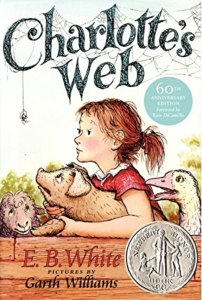
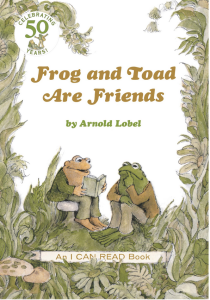
114). An example of low fantasy would be one type of fantasy story known as animal fantasy “in which animals behave as human beings in that they experience emotions, talk, and have the ability to reason,” while still retaining “many of their animal characteristics” (Short et al., 2018, p. 111). Two beloved examples of animal fantasy are Charlotte’s Web by E.B. White (1952) and Frog and Toad Are Friends by Arnold Lobel (1970) in which the animals talk to each other. In the Frog and Toad series, the main characters also wear clothes and their homes are similar to human homes.
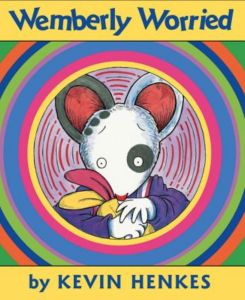 Kate DiCamillo’s The Tale of Despereaux (2003; winner of the Newbery Medal) is an exciting adventure of a mouse who is in love with a princess and tries to save her from a conniving rat and his accomplice, a serving girl. Kevin Henkes is an author of picture books, such as Lilly’s Purple Plastic Purse (1996), Wemberly Worried (2000), and Chrysanthemum (1991),
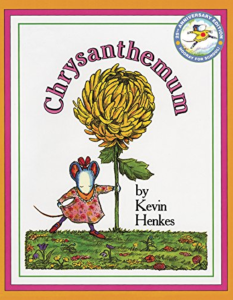 whose characters are mice that have human characteristics and deal with human problems.In Who Wet My Pants? by Bob Shea and illustrated by Zachariah Ohora (2019), Reuben, a bear in a scout troop, wets his pants and proceeds to blame the other animals for wetting his pants, as the other animals tell him that it probably was an accident and it can happen to anyone; to save face, he ends up blaming his pants by saying they sprung a leak.
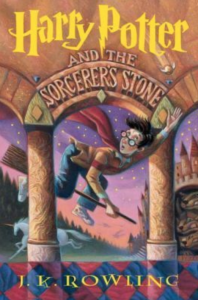
High fantasy books are exemplified by Harry Potter and the Sorcerer’s Stone (1998) and all the books in that series by J.K. Rowling. This series contains all six of the basic fantasy motifs described by Tunnell and colleagues (2012). The first motif is magic, which is the “most basic element” of fantasy (p. 123). Rowling created the wizarding world, a secondary world as another motif, with the main setting as Hogwarts School of Witchcraft and Wizardry, as well as Hogsmeade, the village near Hogwarts, and Diagon Alley, the magical street hidden in London where Harry goes to purchase his books and materials for school and Gringotts Bank, where the magical world occupants keep their fortunes, is located. The focus of the series demonstrates the motif of good, Harry, versus evil, Voldemort, in which Voldemort tries to rise to power again and Harry has to stop him, making Harry the hero of the series, another important motif. The series is full of “special character types,” such as dragons, phoenixes, ghosts, and elves, and “fantastic objects,” such as the Marauders Map, that shows Harry where people are in Hogwarts, and the invisibility cloak, that Harry uses to be invisible, the last of the motifs (p. 125).
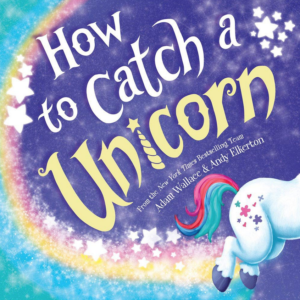
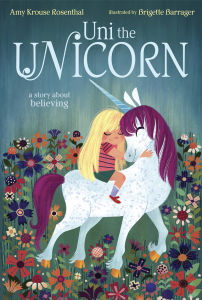
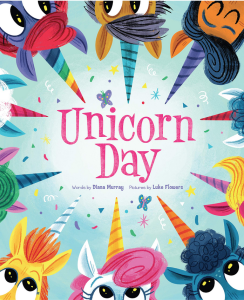
One type of fantasy includes unusual characters (Short et al., 2018; Tunnell et al., 2012) and there have been a number of picture books published with unicorns at their center. In Uni the Unicorn by Amy Krouse Rosenthal (2014), Uni imagines that little girls are real and dreams to have one as a friend. One of the books in the How to Catch series by Adam Wallace and Andy Elkerton is How to Catch a Unicorn (2019), in which a unicorn visits a zoo. Unicorn Day by Diana Murray (2019) describes what unicorns do on their special day. There are many other books with unicorns and other special characters!
Science Fiction
 A genre that is closely connected to fantasy but has a different aim (Tunnell et al., 2012) is science fiction “that features scientifically plausible or technologically
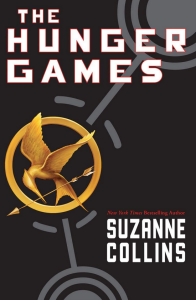
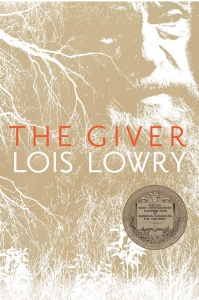 possible developments that were imaginary at the time of publication, but could occur in the future” (Short et al., 2018, p. 108). A popular form of science fiction focuses “on a dystopia, in which authors depict a dark future world of dehumanization and fear” (Short et al., 2018, p. 115). Many dystopian novels are written for an adolescent audience, such as the Hunger Games trilogy by Suzanne Collins (2010); however, Lois Lowry’s award winning book, The Giver (1993), is written for a younger audience, upper elementary and middle school students, and can be a good introduction to dystopian novels.
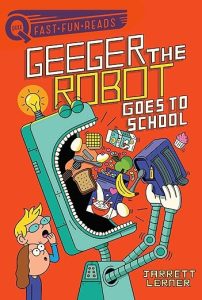 A number of science fiction books have robots as characters who interact with humans. Boy + Bot by Ame Dyckman (2012) is a delightful picture book in which a young boy encounters a robot and while playing together, they discover that they have much in common and become friends. In an easy chapter book to transition students to read more text on the page, Jarrett Lerner created Geeger, a robot who eats food that the people in town don’t want to eat, like moldy bread, and that food turns into electricity to help the town. In Geeger the Robot Goes to School (2020), interesting events take place as Geeger learns what he can and cannot eat at school. Roz is The Wild Robot (Peter Brown, 2016) who is in a shipwreck and washes up on an island that is full of animals. At first the animals are suspicious of Roz, but over time she learns all of their languages so that she can communicate with them and they begin to trust her. She develops many special relationships, especially with a gosling, and has to make difficult decisions to keep her friends safe.
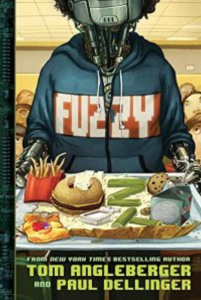
 As readers become middle school students, there are several robot books to interest them. In Fuzzy by Tom Angleberger and Paul Dellinger (2016), the title character, who is a robot, has to integrate into a middle school and meets Max who helps him learn about life in middle school. There is evil lurking in the school and the friends have an adventure to save their school. A world in which humans have been extinct for 30 years is the setting for The Last Human by Lee Bacon (2019), until the main character, a robot, XR_935, whose sole purpose is to install solar panels, meets Emma, a human girl who has been living in an underground bunker her whole life. The two go on a mission with XR_935’s robot co-workers and change the world as they know it. Fantasy and science fiction are genres that grab readers’ attention and takes them on exciting adventures into recreating a version of our world or into a brand-new world. The authors make their worlds believable and have characters that are human or have human-like characteristics who do amazing things with fantastical creatures. There is so much to discover for readers when reading fantasy and science fiction, so enjoy!
***If you have a book recommendation for this or any chapter in this OER, please complete the Google Form: click this link.
Evaluation Questions
- “Does the story have an internal logic and consistency that allows the impossible to seem real? Authors of fantasy must persuade readers to open themselves to believing that which is contrary to reality, strange, whimsical, or magical. This believability is dependent on authors developing a strong internal logic and consistency to their fantasy world and story” (Short et al., 2018, p. 108).
- “Does the author provide a unique imaginative setting? How does the author move the setting beyond the realistic? In some stories, the setting may move beyond the realistic in both time (moving to the past or future or holding time still) and place (imagined worlds); in other stories, only one of these elements (place or time) will go beyond reality” (Short et al., 2018, p. 108).
Books
Fantasy Books
- Rowling, J. K. (1997). Harry Potter and the philosopher’s stone. Bloomsbury.
- Sage, A. (2005). Magyk. Katherine Tegen Books.
- Lewis, C. S. (1950). The lion, the witch and the wardrobe. Geoffrey Bles.
- Funke, C. (2003). Inkheart. The Chicken House.Original German Version:Funke, C. (2003). Tintenherz. Cecilie Dressler Verlag.
- Jones, D. W. (1986). Howl’s moving castle. Greenwillow Books.
- Dahl, R. (1961). James and the giant peach. Alfred A. Knopf.
- Sendak, M. (1963). Where the wild things are. Harper & Row.
- Barrie, J. M. (1911). Peter and Wendy. Hodder & Stoughton.
- Carroll, L. (1865). Alice’s adventures in wonderland. Macmillan and Co.
- L’Engle, M. (1962). A wrinkle in time. Farrar, Straus and Giroux.
- Sutherland, T. T. (2012). The dragonet prophecy. Scholastic.
- Hunter, E. (2003). Into the wild. HarperCollins.
- Flanagan, J. (2005). The ruins of Gorlan. Philomel Books.
- Chainani, S. (2013). The school for good and evil. HarperCollins.
- Mull, B. (2006). Fablehaven. Shadow Mountain.
- Buckley, M. (2005). The fairy-tale detectives. Abrams Books for Young Readers.
- Stephens, J. (2011). The emerald atlas. Alfred A. Knopf.
- Gaiman, N. (1999). Stardust. Spike.
- Nix, G. (2003). Mister Monday. Scholastic.
- Goldman, W. (1973). The princess bride. Harcourt Brace Jovanovich.
Science Fiction Books
- Hatke, B. (2010). Zita the spacegirl. First Second.
- L’Engle, M. (1962). A wrinkle in time. Farrar, Straus and Giroux.
- de Saint-Exupery, A. (1943). The little prince. Reynal & Hitchcock.
- Dahl, R. (1972). Charlie and the great glass elevator. Alfred A. Knopf.
- Dyckman, A. (2012). Boy and bot. Alfred A. Knopf.
- Benton, J. (2004). Lunch walks among us. Simon & Schuster Books for Young Readers.
- O’Brien, R. C. (1971). Mrs. Frisby and the rats of NIMH. Atheneum.
- DuPrau, J. (2003). City of Ember. Random House Children’s Books.
- McNulty, F. (2005). If you decide to go to the Moon. Scholastic Press.
- Lowery, L. (1993). The Giver. Houghton Mifflin Books for Children.
- Pinkwater, D. M. (1979). Alan Mendelsohn, the boy from Mars. Dutton Books for Young Readers.
- Haddix, M. P. (2008). Found. Simon & Schuster Books for Young Readers.
- Farmer, N. (2002). The house of the scorpion. Atheneum Books for Young Readers.
- Card, O. S. (1985). Ender’s game. Tor Books.
- Fox, H. (2004). Eager. Yearling.
- Gibbs, S. (2014). Space case. Simon & Schuster Books for Young Readers.
- Brown, P. (2016). The wild robot. Little, Brown Books for Young Readers.
- DiTerlizzi, T. (2010). The search for Wondla. Simon & Schuster Books for Young Readers.
- Key, A. (1968). Escape to Witch Mountain. Westminster Press.
- Lee, Y. H. (2019). Dragon pearl. Disney Hyperion.
Additional Information
Selected Fantasy and Science Fiction Titles
Angleberger, T., & Dellinger, P. (2016). Fuzzy. Abrams.
Bacon, L. (2019). The Last Human. Abrams.
Brown, P. (2016). The Wild Robot. Little, Brown and Company.
Collins, S. (2010). Hunger Games. Scholastic Press.
DiCamillo, K. (2003). The Tale of Despereaux. Candlewick Press.
Dyckman, A. (2012). Boy + Bot. Alfred A. Knopf.
Henkes, K. (1991). Chrysanthemum. HarperCollins.
Henkes, K. (1996). Lilly’s Purple Plastic Purse. HarperCollins.
Henkes, K. (2000). Wemberly Worried. HarperCollins.
Lerner, J. (2020). Geeger the Robot Goes to School. Aladdin Quix.
Lobel, A. (1970). Frog and Toad are Friends. Harper & Row.
Lowry, L. (1993). The Giver. HMH Books for Young Readers.
Murray, D. (2019). Unicorn Day. Sourcebooks Jabberwocky.
Rosenthal, A. K. (2014). Uni the Unicorn. Random House Studio.
Rowling, J. K. (1998). Harry Potter and the Sorcerer’s Stone. Scholastic.
Shea, B. (2019). Who Wet My Pants? Little, Brown and Company.
Wallace, A., & Elkerton, A. (2019). How to Catch a Unicorn. Sourcebooks Wonderland.
White, E. B. (1952). Charlotte’s Web. HarperCollins.
Additional Resources
References
- Buss, K., & Karnowski, L. (2000). Teaching Fantasy. In Reading and Writing Literary Genres (pp. 113-131). International Reading Association, Inc.
- Goldman, J.G. (2014, March 27). When animals act like people in stories, kids can’t learn. Scientific American. https://blogs.scientificamerican.com/thoughtful-animal/when-animals-act-like-people-in-stories-kids-cane28099t-learn/
- Short, K. G., Lynch-Brown, C. & Tomlinson, C. M. (2018). Fantasy and science fiction. In Essentials of Children’s Literature (9th ed., pp. 107-119). Pearson Education, Inc.
- Tunnell, M.O., Jacobs, J.S., Young, T.A., & Bryan, G.W. (2012). Modern fantasy. In Children’s Literature, Briefly (5th ed., pp. 120-132). Pearson Education, Inc.