Chapter 12: Historical Fiction
Introduction
How do you know what it was like to be an orphan surviving in 12th -century Korea? What about experiencing a battle of the Civil War? What about the hardships of living on the prairie in the late 1800s? Being sent to live in the countryside of England in World War II to get away from the bombing in London or saving your Jewish best friend from going to a concentration camp in Nazi-occupied Denmark? Being an African-American family in the middle of a defining event in the Civil Rights Movement in Birmingham, Alabama in 1963? Experiencing the building of the Berlin Wall and dividing your family between East and West Germany? Children can read and learn about these historical events and time periods in social studies textbooks, but are able to live through the experiences of fictional characters during these historical events and time periods and many, many more through historical fiction. As Tunnell, Jacobs, Young, and Bryan (2012) state, “Historical fiction can breathe life into what students may have considered irrelevant and dull…” (p. 148). Historical fiction can be “used for the sheer purpose of helping students see historical events through a more personal perspective—that is, through the eyes and ears of the characters about whom they are reading” (Truax, 2010, p. 47).
Main Content
Principles and Examples of Historical Fiction
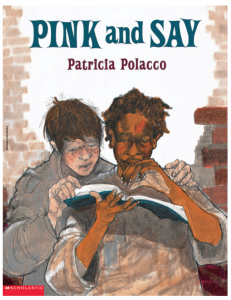
When evaluating historical fiction, there are principles that are important to keep in mind. First, historical fiction allows readers to examine “conflicting viewpoints” and “differing perspectives”(Tunnell et al., 2012, p. 150). For example, there are many historical fiction books set in the Civil War. For example, there are many historical fiction books set in the Civil War. Four such books have male protagonists who experience the Civil War in different ways. One of the books is a picture book, Pink and Say by Patricia Polacco (1994), about two boys who meet on a Civil War battlefield and develop the bonds of brotherhood as they learn more about each other and face the dangers of war.
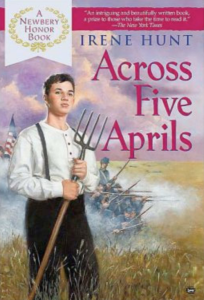 In Across Five Aprils by Irene Hunt (1964), the Civil War is experienced through Jethro and his family across the time that the war lasted, five Aprils. Three of the books are chapter books that offer varying perspectives of the war.
As the main character in Charley Skedaddle by Patricia Beatty (1987), Charley joined the Union Army as a drummer boy and finds his courage after he “skedaddles” from a battle in Virginia during which he shoots a Confederate soldier.
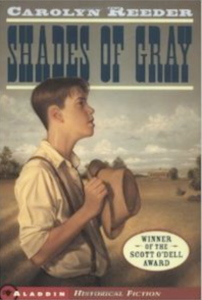 Finally, Shades of Gray by Carolyn Reeder (1989) is set after the Civil War during which Will has to leave his home in the Shenandoah Valley because his entire immediate family has died, which Will blames on the Union Army, to go live with his uncle who refused to fight for the Confederate Army.
Another principle is the truth about history should be presented honestly (Tunnell et al., 2012). An example that is at the character level happens in The War That Saved My Life by Kimberly Brubaker Bradley (2015). Ada, the main character, has clubfoot that shames her mother, so Ada never goes outside and watches the world from her apartment window. As a victim of child abuse, she fears that when her mother comes home, she will be angry with Ada and lock her in a cabinet. The book is set during World War II and the German bombing of London is just starting, so children are being sent to the country for safety. When Ada’s little brother, Jamie, gets to go, Ada sneaks away with him and her life is forever changed by her experiences away from her mother.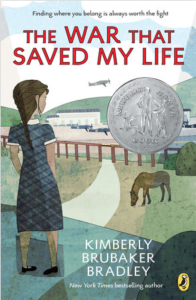
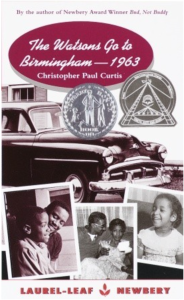 When considering the truth about the time period in which the historical fiction takes place, an example is The Watsons Go to Birmingham – 1963 by Christopher Paul Curtis (1995). The Watson family leaves Flint, Michigan to drive to Birmingham, Alabama to visit their grandmother. While there, the family is thrust in the middle of an historic event, the bombing of the 16th St. Baptist Church where the middle son, Kenny, the main character, goes to the church where he thinks his sister is attending Sunday school. The book explores the feelings Kenny has as he deals with witnessing this horrible event.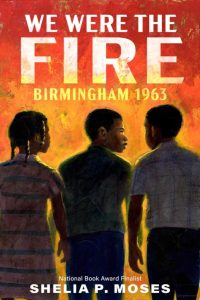
Another important principle is that historical fiction has “an infrastructure of accurate historical facts” (Tunnell et al., 2012, p. 152). This is particularly necessary when the historical fiction book is set in a time period that the “author has not personally experienced” (p. 154). To write A Single Shard, Linda Sue Park (2001) had to do meticulous research about 12th-century Korea to tell the story of an orphan, Tree-ear, who lives in a potter’s village and has to pay the consequences when he breaks a pot of a master potter. 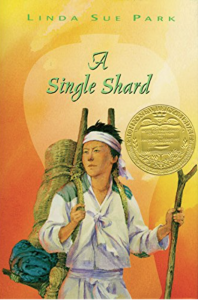
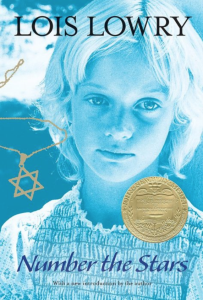 An obvious principle of historical fiction for children and young adults is that the protagonist should be about their age (Jordan, 2004; Tunnell et al., 2012). In Lois Lowry’s book about the Nazi occupation of Denmark, Number the Stars (1989), the protagonist is not a Jewish character as in other books about the Holocaust, but ten-year-old Annemarie Johansen, who “becomes directly involved in the resistance when she learns that she must help to hide her Jewish best friend, Ellen, and her parents” (Jordan, 2004, p. 211).
In an historical fiction book that takes place after World War II, A Night Divided by Jennifer A. Nielsen (2015), the main character, Gerta, is a slightly older twelve-year-old girl who lives in East Berlin with her family while the Berlin Wall is being constructed. When her father and one of her brothers travel to West Berlin for a short trip, the Berlin Wall is finalized to close the border between East and West Berlin and they cannot get back to Gerta, her mother, and other brother. A series of nail-biting events happen to reunite Gerta’s family. 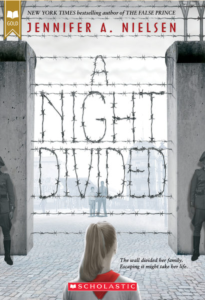
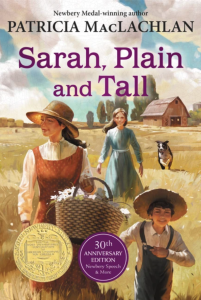 Many of the historical fiction books that have been highlighted are told in the third-person perspective, but there are also books that are told in the first-person point of view. As Mitchell (2003) states, “…first-person narrative limits the events the reader can see to only those the narrator sees and…a person can be in only one place at one time” (p. 278), so this does not allow the reader to experience as much of the narrative. One historical fiction book that uses the first person point of view is Sarah, Plain and Tall by Patricia MacLachlan in which Anna tells the story of her family who lives on the prairie in the late 1800s. Her mother died in childbirth when her brother, Caleb, was born. Her father, Jacob, puts an ad in a newspaper on the East Coast for a mail order bride and Sarah, who is from the Maine coast, answers the ad. By telling the story in the first person perspective, the reader is better able to understand the feelings Anna has when Sarah arrives on the prairie and the hope she feels that Sarah will stay and become part of her family.
In the series, “You Choose,” the historical fiction story is written in the second person so that you, as the reader, are part of the action and you choose what happens to you in the story. One of the books, Fighting for Freedom Along the Underground Railroad: A History Seeking Adventure by Shawn Pryor (2024), provides a number of pathways for an enslaved person to escape from slavery and try to get to freedom north of the Mason-Dixon line. In these storylines, you, the enslaved person, run away from your plantation with several options, including escaping in a crate and traveling on the Underground Railroad. This series has a range of historical fiction stories so that readers can experience different wars and historical events firsthand as a participant. 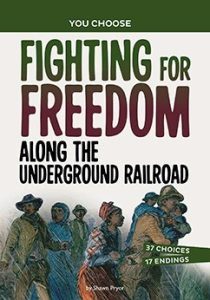
Historical fiction provides an important window into what life was like in different time periods in history by allowing the reader to live through the experiences of the characters. Teachers and librarians can effectively connect their students to the social studies curriculum by incorporating historical fiction in the classroom. Students can get a deeper understanding about what they are learning as they read about the accurate information of the time period in history woven into the experiences of the characters. What better way is there to learn about history?
Historical fiction provides an important window into what life was like in different time periods in history by allowing the reader to live through the experiences of the characters. Teachers can effectively connect their students to the social studies curriculum by incorporating historical fiction in the classroom. Students can get a deeper understanding about what they are learning as they read about the accurate information of the time period in history woven into the experiences of the characters. What better way to learn about history?
Books
- Erdrich, L. (1999). The birchbark house. Hyperion Books.
- Ryan, P. M. (2000). Esperanza rising. Scholastic Inc.
- Lowery, L. (1989). Number the stars. Houghton Mifflin Harcourt.
- Rhodes, J. P. (2013). Sugar. Little, Brown and Company.
- Cline-Ransome, L. (2018). Finding Langston. Holiday House.
- Park, L. S. (2002). When my name was Keoko. Clarion Books.
- Webb, H. (2015). The case of the stolen sixpence. Houghton Mifflin.
- Draper, S. M. (2015). Stella by starlight. Atheneum Books for Young Readers.
- Kalmar, D. (2018). A stitch in time. Feiwel and Friends.
- Kelly, J. (2009). The evolution of Calpurnia Tate. Henry Holt and Company.
- Krishnaswami, U. (2017). Step up to the plate, Maria Singh. Tu Books.
- Mattick, L., & Greenhut, J. (2018). Winnie’s great war. Little, Brown and Company.
- Shabazz, I., & Watson, R. (2018). Betty before x. Farrar, Straus and Giroux.
- Tubb, K. O. (2018). The story collector. Henry Holt and Company.
- Curtis, C. P. (1995). The Watsons go to Birmingham- 1963. Yearling.
- Vawter, V. (2013). Paper boy. Delacorte Press.
- Lai, T. (2011). Inside out & back again. HarperCollins.
- Conkling, W. (2011). Sylvia & Aki. Tricycle Press.
- Giff, P. R. (1997). Lily’s crossing. Delacorte Press.
- Lord, B. B. (1984). In the year of the boar and Jackie Robinson. HarperCollins.
- Bulla, R. C. (1981). A lion to guard us. HarperTrophy.
- MacLachlan, P. (1985). Sarah, plain and tall. HarperTrophy.
- Moses, S. P. (2004). The legend of Buddy Bush. Margaret K. McElderry Books.
Additional Information
Selected Historical Fiction Titles
Beatty, P. (1987). Charley Skedaddle. New York: Troll.
Bradley, K.B. (2015). The War That Saved My Life. New York: Puffin Books.
Curtis, C.P. (1995). The Watson’s Go to Birmingham – 1963. New York: Yearling.
Hunt, I. (1964). Across Five Aprils. New York: Berkley Books.
Lowry, L. (1989). Number the Stars. New York: Yearling.
MacLachlan, P. (1985). Sarah, Plain and Tall. New York: HarperCollins Children’s Books.
Nielsen, J.A. (2015). A Night Divided. New York: Scholastic Press.
Park, L.S. (2001). A Single Shard. New York: Dell Yearling Book.
Polacco, P. (1994). Pink and Say. New York: Philomel Books.
Reeder, C. (1989). Shades of Gray. New York: Aladdin Paperbacks.
References
- Jordan, S.D. (2004). Educating without overwhelming: Authorial strategies in children’s Holocaust literature. Children’s Literature in Education, 35(3), 199-218.
- Mitchell, D. (2003). Realistic and historical fiction. In Children’s Literature: An Invitation to the World (pp. 258-299). New York: Allyn and Bacon.
- Truax, M. (2010). Terrific teaching tips: Reading historical texts: Comprehension through strategies and extensions. Illinois Reading Council Journal, 38(4), 47-52.
- Tunnell, M.O., Jacobs, J.S., Young, T.A., & Bryan, G.W. (2012). Historical fiction. In Children’s Literature, Briefly (5th ed., pp. 148-160). Boston, MA: Pearson Education, Inc.