"

Chapter 2: History of Children’s Literature

Introduction

This chapter was written by Jenifer Jasinski Schneider in 2016, the author of an OER entitled, The inside, outside, and upside downs of children’s literature: From poets and pop-ups to princesses and porridge. The authors of A Guide to Children’s Literature received permission to use original content from this OER under a Creative Commons Attribution-Noncommercial-No Derivative Works 4.0 License

At its best, children’s literature includes books of the highest caliber, representing complex plots or concepts in both word and art. Children’s literature is often defined as a collection of books written for children, read by children, and/or written about children. But this definition may be too simplistic for a not-so-simple genre.

Main Content

What is Children’s Literature?

I revise the previously provided definition of children’s literature from a collection of books written for children, read by children, and/or written about children to:

Children’s literature is an assortment of books (and not books) written for children (and adults), read by children (and adults), and written about children (but not necessarily).

That was a better definition. But it is not completely inclusive. As further evidence, I submit the following:

Children’s literature is a collection of books as old as the printing press (Figure 2.1)

The book cover for A Little Pretty Pocket-Book
Figure 2.1. Gutenberg invented movable type printing around 1439 and children’s books evolved alongside changes in the printing process. Although not the very first children’s book, A Little Pretty Pocket Book was an influential publication. A Little Pretty Pocket Book by John Newbery, 1744, Worcester, MA: Isaiah Thomas. Copyright expired.
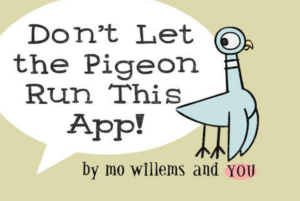
and as new as the latest app (Figure 2.2).


This book cover for Don't Let The Pigeon Run This App!
Figure 2.2. Popular book characters can lead to popular apps. Don’t Let the Pigeon Run This App by Mo Willems and you, 2022, Glendale, CA: Disney Enterprises Inc. Cover art copyright 2011 by Disney Enterprises Inc.

Children’s literature portrays all aspects of humanity (Figure 2.3),
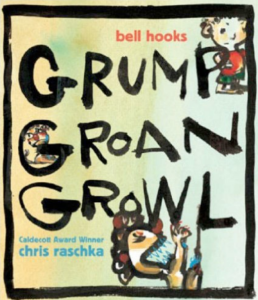
The book cover for Grump Groan Growl
Figure 2.3. Some children’s literature deals with everyday emotions as demonstrated in Grump, Groan, Growl by bell hooks and illustrated by Chris Raschka, 2008, New York, NY: Disney Hyperion. Cover art copyright 2008 by Chris Raschka.

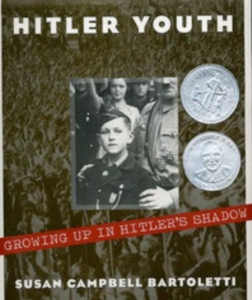
inhumanity (Figure 2.4)

The book cover for Hitler Youth
Figure 2.4. Many forms of children’s literature explore the dark side. For example, learn how Hitler exploited children in Hitler Youth: Growing Up in Hitler’s Shadow by Susan Campbell Bartoletti, 2005, New York, NY: Scholastic. Copyright 2005 by Susan Campbell Bartoletti.

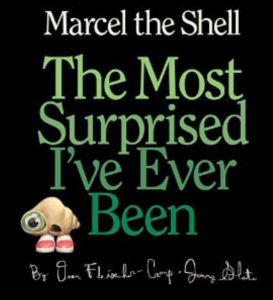
and non-humanity (Figure 2.5),

The book cover for Marcel the Shell: The Most Suprised I've Ever Been
Figure 2.5. Children’s literature is full of memorable characters. He’s not human, but he acts like one. Marcel the Shell: The Most Surprised I’ve Ever Been by Dean Fleischer-Camp and Jenny Slate, 2014, New York, NY: Razorbill. Copyright 2014 by Dean Fleischer-Camp.

all periods of human history (Figure 2.6)

The book cover for The Death of the Hat
Figure 2.6. Children’s literature includes unique views of history. The Death of the Hat: A Brief History of Poetry in 50 Objects by Paul B. Janeczko and Illustrated by Chris Raschka, 2015, Somerville, MA: Candlewick. Cover art copyright 2015 by Chris Raschka.​

and all places of this world (Figure 2.7)
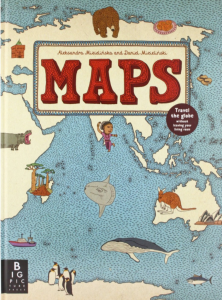
The book cover for Maps
Figure 2.7. Children’s literature covers the whole world. Maps by Aleksandra Mizielinski and Daniel Mizielinski, 2013, New York, NY: Big Picture Press. Copyright 2013 by Aleksandra Mizielinski and Daniel Mizielinski.

as well as worlds beyond (Figure 2.8).
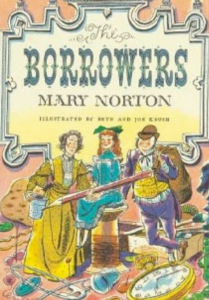
Cover of The Borrowers
Figure 2.8. Explore the secret worlds of your imagination in children’s literature. The Borrowers by Mary Norton and illustrated by Beth Krush and Joe Krush, 1953, New York, NY: Harcourt Brace. Cover art copyright 1953 by Beth Krush and Joe Krush.

Children’s literature is poetry (Figure 2.9),
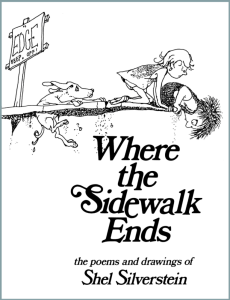
Cover of Where the Sidewalk Ends
Figure 2.9. Where the Sidewalk Ends is a standard book in any library collection. Where the Sidewalk Ends by Shel Silverstein, 1974, New York, NY: Harper & Row. Copyright 1974 by Shel Silverstein.fiction (Figure 2.10),

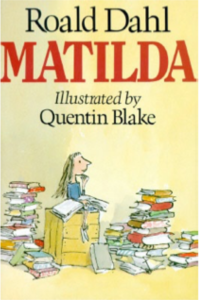
fiction (Figure 2.10),

Cover of Matilda
Figure 2.10. Children’s literature includes world famous storytellers. Matilda by Roald Dahl and illustrated by Quentin Blake, 1988, New York, NY: Penguin. Cover art copyright by Quentin Blake.

nonfiction (Figure 2.11),

Cover of From Seed to Plant
Figure 2.11. Children’s literature explains everything we need to know. From Seed to Plant by Gail Gibbons, 1993, New York, NY: Holiday House. Copyright 1993 by Gail Gibbons.

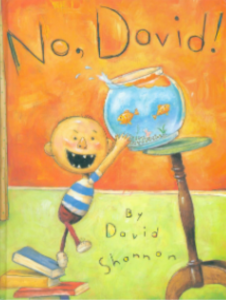
argument (Figure 2.12),

Cover of No, David!
Figure 2.12. Children’s literature portrays human qualities, desires, and perspectives. No, David! By David Shannon, 1998, New York, NY: Blue Sky Press. Copyright 1998 by David Shannon.

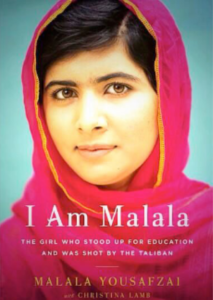
and biography (Figure 2.13).

Cover of I Am Malala
Figure 2.13. Children’s literature demonstrates human resilience and power. I am Malala: The Girl Who Stood Up for Education and Was Shot by the Taliban by Malala Yousafzai and Christina Lamb, 2013, New York, NY: Little, Brown and Company. Copyright 2013 by Malala Yousafzai and Christina Lamb

Children’s literature includes picturebooks (Figure 2.14)

Cover of Jumanji
Figure 2.14. Jumanji by Chris Van Allsburg, 1981, New York, NY: Houghton Mifflin Harcourt. Copyright 1981 by Chris Van Allsburg.

and pop-up books (Figure 2.15; Video 2.1),
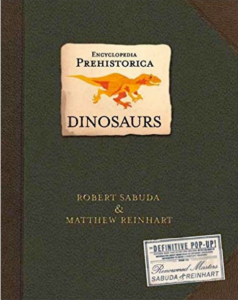
Cover of Encyclopedia Prehistorica Dinosaurs: The Definitive Pop-Up 
Figure 2.15. Encyclopedia Prehistorica Dinosaurs: The Definitive Pop-Up by Robert Sabuda and Matthew Reinhart, 2005, New York, NY: Candlewick. Copyright 2005 by Robert Sabuda and Matthew Reinhart.

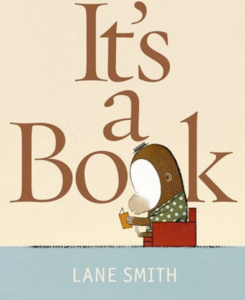
paper books (Figure 2.16)

Cover of It's a Book
Figure 2.16. It’s a Book by Lane Smith, 2010, New York, NY: Roaring Brook Press. Copyright 2010 by Lane Smith.

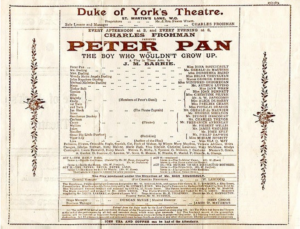
plays (Figure 2.17)

Playbill of Peter Pan: The Boy Who Wouldn’t Grow Up
Figure 2.17. Peter Pan: The Boy Who Wouldn’t Grow Up by J.M. Barrie, 1904, London, England: Hodder & Stoughton. Copyright 1988 by Great Ormond Street Hospital.

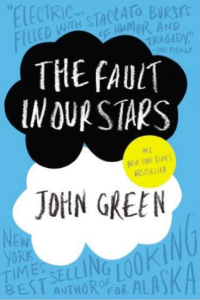
and digital texts (Figure 2.18).

Cover of the Fault in Our Stars
Figure 2.18. The Fault in Our Stars by John Green, 2012, New York, NY: Penguin. Copyright 2012 by John Green.

Children’s literature includes many stories (Figure 2.19)
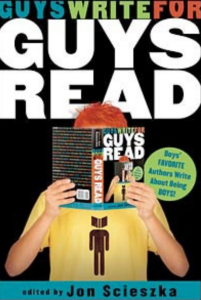
Cover of Guys Write for Guys Read
Figure 2.19. Guys Write for Guys Read edited by Jon Scieszka, 2005, New York, NY: Viking Press. Copyright 2005 by Jon Scieszka.

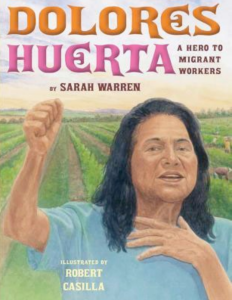
and single stories (Figure 2.20),

Cover of Delores Huerta: A Hero to Migrant Workers
Figure 2.20. Delores Huerta: A Hero to Migrant Workers by Sarah Warren and illustrated by Robert Casilla, 2012, Seattle, WA: Two Lions. Cover art copyright 2012 by Robert Casilla.

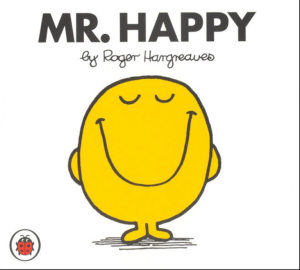
happy stories (Figure 2.21),

Cover of Mr. Happy
Figure 2.21. Mr. Happy by Roger Hargreaves, 1971, London, England: Price Stern Sloan. Copyright 1971 by Roger Hargreaves.

sad stories (Figure 2.22),

Cover of Sad Underwear and Other Complications
Figure 2.22. Sad Underwear and Other Complications by Judith Viorst and illustrated by Richard Hull, 200, New York, NY: Atheneum. Cover art copyright 2000 by Richard Hull.

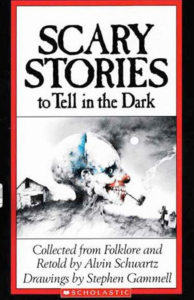
scary stories (Figure 2.23),

Cover of Scary Stories to Tell in the Dark
Figure 2.23. Scary Stories to Tell in the Dark by Alvin Schwartz and illustrated by Stephen Gammell, 1981, New York, NY: Scholastic. Cover art copyright 1981 by Stephen Gammell.

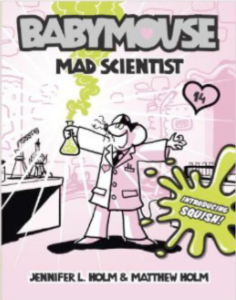
mad stories (Figure 2.24),

Cover of Babymouse #14: Mad Scientist
Figure 2.24. Babymouse #14: Mad Scientist by Jennifer Holm and illustrated by Matthew Holm, 2011, New York, NY: Random House Books for Young Readers. Cover art copyright 2011 by Matthew Holm.

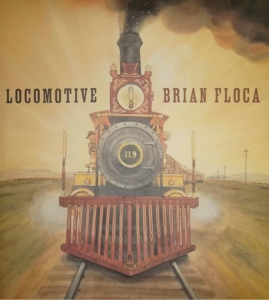
and not stories (Figure 2.25)

The book cover for Locomotive
Figure 2.25. Locomotive by Brian Floca, 2013, New York, NY: Atheneum Books for Young Readers. Copyright 2013 by Brian Floca.

Children’s literature is created for and read by children, adolescents, and adults. Children’s literature is high art, extraordinary writing, and everything in-between.

It’s difficult to appreciate the 3D art of pop-up artists like Robert Sabuda and Matthew Reinhart in a 2D, non-moving, space. To see some of the intricacies in pop up books, watch this pop up video:

Video 2.1 Look, Touch, Shake, and Swipe: Pop Up Books and Interactive eBooks http://www.kaltura.com/tiny/wlrn1.

A Working Definition

Children’s literature is a label for collections of texts that are specifically written and/or illustrated for and/or about youth as well as texts that are not specifically written and/or illustrated for and/or about youth but which youth choose to read, view, and/or write. Adults are welcome to read children’s literature too—many do.

Children’s literature provides encounters with the world that shape the meaning children make of the world (Kiefer, Hepler, Hickman, Huck, 2007). Having a vicarious or “lived through” experience with literature, builds readers’ aesthetic responses and perceptions (Rosenblatt, 1978). Reading literature increases one’s sensitivity to the power of the written word (Sipe, 2008) and contributes to visual expression (Brenner, 2011; Sipe, 2011). For these reasons, adults study children’s literature as scholars, critics, educators, librarians, entrepreneurs, and social commentators.

A Brief History of Children’s and Young Adult Literature

With my almost anything goes orientation toward children’s literature broadly detailed, let’s take a look at how this body of literature came to be through selected examples and important artifacts.

The origins of children’s literature are hard to nail down. Do cave illustrations count? In my opinion, why not? There is evidence cave paintings included children (2015, November 10, Retrieved from http://www.telegraph.co.uk/news/earth/earthnews/8798392/Childrens-prehistoric-cave- paintings-discovered.html).

I accept different formats of text as representatives of children’s literature (and by text I am referring to symbolic systems of meaning). I realize cave paintings are not “books,” but they were a form of communication most relevant and accessible to the people of that time.

I am not obsessed with the content of the cave drawings either. If hunting deer was the trending topic of ancient people, then children and young adults needed to know about it. Cave youth needed to access others’ thoughts and ideas. They needed information.

Somewhere between prehistoric cave people and the Renaissance, the Sumerians and others invented cuneiform to represent sounds that captured human speech, the Egyptians developed hieroglyphs for record-keeping, and the Chinese used oracle bones and inscriptions to communicate with their ancestors (2015, November 10, Retrieved from http://www.britishmuseum.org/ explore/themes/writing/historic_writing.aspx). Gutenberg created a printing press and the speed of information exchange increased dramatically (2015, November 10, http://www.history.com/topics/ middle-ages/videos/mankind-the-story-of-all-of-us-the-printing-press). Here are a few examples.


1400’s : A 1485 Italian edition of Aesopus Moralisatus by Bernardino di Benalli (Figure 2.26).
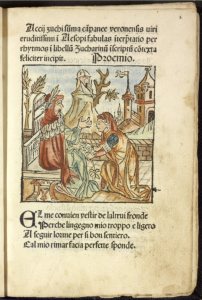
Image of Aesopus Moralisatus
Figure 2.26. An Italian translation of Aesop’s Fables was published as Aesopus Moralisatus by Bernardino di Benalli, 1485, Venezzia, Italy. Copyright 1485 by Bernardino di Benalli. The book is available for viewing at https://en.wikipedia.org/wiki/Aesop%27s_Fables#/media/File:Aesopus_-_Aesopus_moralisatus,_circa_1485_-_2950804_Scan00010.tif 

1500’s: Michael Agricola’s ABC book published in 1559 (Figure 2.27)
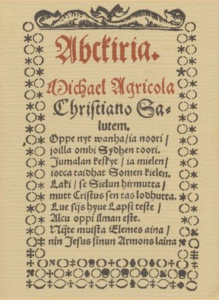
Cover of Abckiria
Figure 2.27. Abckiria is the first children’s book in Finnish, written by Bishop Michael Agricola (c. 1510-1557), 1559, Helsinki, Finnland: Finnish Literature Society. Copyright 1558 by Michael Agricola. The complete book is available for viewing at http://childrenslibrary.org/library/books/a/agrabck_00070001/index.html

1600’s: Johannes Amos Comenius’ Orbis Pictus, 1657, is widely considered to be the first picturebook school book (Comenius, 1896) (Figure 2.28).
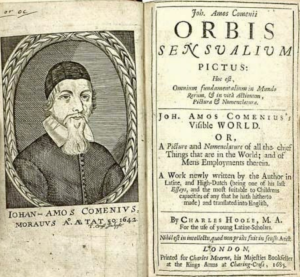
Cover of Orbis Pictus
Figure 2.28. Johannes Amos Comenius’ Orbis Pictus, 1657, is widely considered to be the first picturebook school book (Comenius, 1896). Orbis Pictus by Johannes Amos Comenius, 1685, London, England: Charles Mearne. Copyright expired. The 1728 edition is available for viewing at https://www.gutenberg.org/ebooks/28299?msg=welcome_strange

1700’s: The Catechism of Nature for the Use of Children by Dr. Martinet published in 1793 (Figure 2.29).
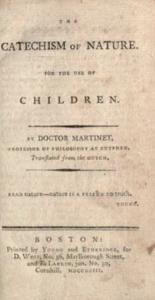
 

Cover of The Catechism of Nature for the Use of Children
Figure 2.29. The Catechism of Nature for the Use of Children by Dr. Martinet was published in 1793. Figure 2.29 is an English version translated from Dutch. The Catechism of Nature for the Use of Children by Dr. Martinet, 1793, Boston, MA: Young and Etheridge. Copyright expired.

As these representative texts indicate, writing evolved across cultures and through various modes and media. Tablets, stones, pamphlets, and books were vehicles for conserving history or sharing information among scholars, the wealthy, and royalty.

Eventually, the creation of chapbooks, and other forms of cheaply-produced texts, increased people’s access to books. Chapbooks often featured rhymes, fairy tales, or alphabet books along with crime stories, songs, and prophecies; however, children were not the only target audience of these texts (2015, November 10, Retrieved from http://www.vam.ac.uk/content/ articles/n/national-art-library-chapbooks-collection/).

Fairy tales, collected by the Brothers Grimm as part of their study of linguistics, were oral stories that were shared among adults. Their work was not necessarily intended for children either (Ashliman, 2013, Retrieved from http://www.pitt.edu/~dash/grimm.html).

Of course, children read the texts of their times, or listened to the stories around them, but they only had access to the books that were placed within their lives.

Parallel to the publication of chapbooks, publishers developed instructional materials specifically for children (Video 2.2). Spelling books, primers, and alphabet books were intended to support religious and/or academic instruction for children. Yet, the notion of reading for pleasure or the production of texts specifically for children’s amusement was not a priority.

Video 2.2: The Didactic Origins of Children’s Literature by Melanie Griffin. http://www.kaltura.com/tiny/vnmbg

For the most part, the 18th century was the time period in which “children’s literature” became a thing. According to Professor M.O. Grenby (2015), Professor of Eighteenth- Century Studies in the School of English at Newcastle University,

“A cluster of London publishers began to produce new books designed to instruct and delight young readers. Thomas Boreman was one, who followed his Description of Three Hundred Animals (Figure 2.30) with a series of illustrated histories of London landmarks jokily (because they were actually very tiny) called the Gigantick Histories (1740-43).”

Inside A Description of Three Hundred Animals
Figure 2.30. A Description of Three Hundred Animals by Thomas Boreman, 1730, London, England: Thomas Boreman. Copyright expired.

Another was Mary Cooper, whose two-volume Tommy Thumb’s Pretty Song Book (1744) is the first known nursery rhyme collection, featuring early versions of well-known classics like ‘Bah, bah, a black sheep’, ‘Hickory dickory dock’, ‘London Bridge is falling down’ and ‘Sing a song of sixpence’ (Figure 2.31).
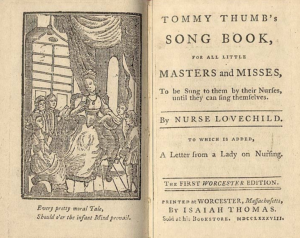
Image of the inside of Tommy Thumb’s Pretty Song Book 
Figure 2.31. Image from Tommy Thumb’s Pretty Song Book by Mary Cooper, 1788, Worcester, MA: Isaiah Thomas. Copyright expired.

But the most celebrated of these pioneers is John Newbery, whose first book for the entertainment of children was A Little Pretty Pocket-Book Intended for the Instruction and Amusement of Little Master Tommy and Pretty Miss Polly (c.1744) (Figure 2.32). – See and read more at: (Grenby, 2015, Retrieved from http://www.bl.uk/romantics-and-victorians/articles/the-origins-of-childrens-literature#sthash.6MIH4VoM.dpuf).
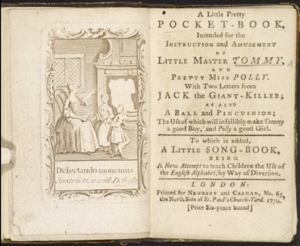
Image of the inside of A Little Pretty Pocket-Book Intended for the Instruction and Amusement of Little Master Tommy and Pretty Miss Polly
Figure 2.32. John Newbery published A Little Pretty Pocket-Book Intended for the Instruction and Amusement of Little Master Tommy and Pretty Miss Polly in 1744. Image A Little Pretty Pocket-Book Intended for the Instruction and Amusement of Little Master Tommy and Pretty Miss Polly by John Newbery, 1770, London, England: Newbery and Carnan. Copyright expired.


With the development of improved printing processes and the recognized value of books and literacy, the field of children’s literature shifted and expanded.

1800’s: The Adventures of Robinson Crusoe written by Daniel Defoe and illustrated by Paul Adolphe Kauffman (1884) is still widely read and this version boasts “coloured illustrations” on the book cover (Figure 2. 33).
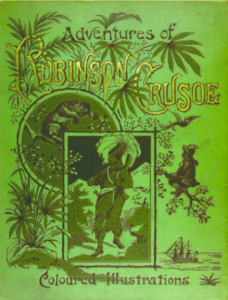
Cover of The Adventures of Robinson Crusoe
Figure 2.33. The Adventures of Robinson Crusoe written by Daniel Defoe and illustrated by Paul Adolphe Kauffman, 1884, London England: T. Fisher Unwin. Copyright expired. View the book via Children’s Library.

1900’s: By the 1900’s, children’s literature was more pervasive in homes, libraries, and schools. The global importance of children’s literature is represented in books published in many languages all over the world (Figures 2.34, 2.35, 2.36, 2.37)
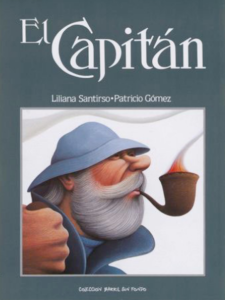
Cover of El Capitan
Figure 2.34. El Capitán by Liliana Santirso and illustrated by Patricio Gómez, 1998, Mexico: Celta Amaquemecan. Cover art copyright 1998 by Patricio Gómez. View the book via Children’s Library.
Cover of All We Need Are Dragons
Figure 2.35. All We Need Are Dragons by Ljubivoje Ršumović and illustrated by Dušan Petričić, 1990, Serbia: Rad. Cover art copyright 1990 by Rad. View the book via Children’s Library.
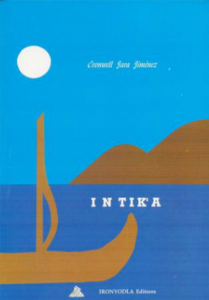
Cover of Intik’a: How the Taquileo island was not an island but a very tall mountain that was called Intik’a
Figure 2.36. Intik’a: How the Taquileo island was not an island but a very tall mountain that was called Intik’a by Cronwell Jara Jiménez, 1995, Lima, Peru: Ironyodla. Copyright 1995 by Cronwell Jara Jiménez. View the book via Children’s Library


Cover of Mbegu Ya Ajabu (The Amazing Seed)
Figure 2.37. Mbegu Ya Ajabu (The Amazing Seed) by Deus. M. Richard, 1997, Kenya: Sasa Sema. Copyright 1997 by Readit Books. View the books via Children’s Library


2000’s: More recently, children’s literature has taken a digital turn. In addition to ebooks, attempts to reflect diverse perspectives have increased with open access publishing and grass-roots promotion through social networking. For example, the Anna Lindh Foundation promotes Arab children’s literature (http://www.arabchildrensliterature.com/about).

Children’s books are an important part of civilization. The creation of children’s literature led to changes in how children read, how children learn in school, and how children understand the world. Yet none of the changes would have been possible without access to books.

License

Icon for the Creative Commons Attribution-NonCommercial 4.0 International License

A Guide to Children’s Literature Copyright © 2022 by Lisa Cipolletti, Valerie Robnolt, and Elizabeth Morris is licensed under a Creative Commons Attribution-NonCommercial 4.0 International License, except where otherwise noted.

Share This Book