Want to create or adapt books like this? Learn more about how Pressbooks supports open publishing practices.
Chapter 3: Evaluating Literature, Elements of Quality Literature and Literary Awards
Introduction
This chapter was written by Jenifer Jasinski Schneider in 2016, the author of an OER entitled, The inside, outside, and upside downs of children’s literature: From poets and pop-ups to princesses and porridge. The authors of A Guide to Children’s Literature received permission to use original content from this OER.
Given the origins of children’s literature as a mode of communication, an instructional resource, and a literary object, the study of children’s literature is most often pursued by scholars in the fields of English, Library Science, and Education.
However, with the moneymaking potential of children’s literature, its ability to communicate political and social messages, as well as its documentation of shifting instantiations of culture and language, children’s literature is also studied by anthropologists, sociologists, psychologists, historians, business analysts, and content experts.
Children’s literature has wide appeal and broad impact. With so much attention from various fields, the value experts place on children’s literature can appear contradictory. Understandably, different experts attend to the aspects of children’s literature that are most relevant and important to them. In a nutshell, it’s all relative.
Main Content
The Experts Who Study Children’s Literature
As in any field, quality is rewarded with recognition and awards. But what exactly do the experts look for and who gets the recognition?
Let’s take a look at my view of the field of children’s literature. Who are the experts? What do they value? Does it really matter?
The views expressed in this book are those of the author and do not necessarily reflect the views of those who view themselves as experts in the field of children’s literature.
The Librarians
In the field of children’s literature, the primary group that serves to collect, catalogue, monitor, distribute, and recognize books for children and youth are the librarians. In the US, the American Library Association (www.ala.org) is the leading organization for librarians. The ALA advocates for libraries and librarians, provides education and lifelong learning for all people, actively defends the right to read and other forms of intellectual freedom, advocates for equitable access to information, spaces, and library services, and supports literacy initiatives. Just as books have transformed from bounded, printed texts, the library manages and maintains all forms of text including books, electronic resources, graphic material, and multimedia.
ALA is divided into 11 divisions to meet the needs of librarians who work in different types of libraries or library specializations. Two divisions focus on children’s and young adult literature: the Association for Library Service to Children (ALSC) and the Young Adult Library Services Association (YALSA).
Two divisions of the ALA focus on the children’s and young adult literature:
The ALA recognizes children’s and young adult books, print, and media with over 30 awards and prizes for authors, illustrators, librarians, and educators. The awards are searchable and listed on the ALA website (http://www.ala.org/awardsgrants/awards/browse/bpma/all/cyad).
Association for Library Service to Children (ALSC). The ALSC is the world’s largest organization dedicated to the support and enhancement of library service to children. The ALSC administers nine book awards for children’s literature. Of these awards, the Newbery and Caldecott Medals are widely considered to be the most prestigious.
Figure 3.1. A Little Pretty Pocket Book by John Newbery, 1744, Worcester, MA: Isaiah Thomas. Copyright expired.
The Newbery Medal. The Newbery Medal is named after John Newbery, a London publisher, who is credited with creating the first book written and published for the entertainment of children (e.g., A Little Pretty Pocket-Book Intended for the Instruction and Amusement of Little Master Tommy and Pretty Miss Polly, c.1744, Figure 3.1). As such, John Newbery is often called the “father” of children’s literature. The Newbery Medal is awarded to the author of the most distinguished contribution to American literature for children.
Prior to Newbery, other books were written for children, but they were focused on moral development or literacy instruction. John Newbery recognized the entertainment potential of text.
Presentation of information including accuracy, clarity, and organization;
Development of a plot;
Delineation of characters;
Delineation of a setting;
Appropriateness of style.
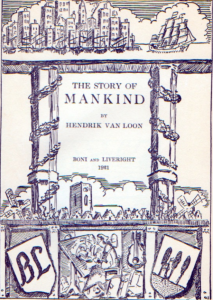
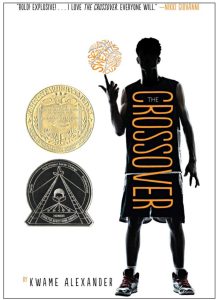
The first Newbery was awarded in 1922 for The Story of Mankind by Hendrik Willem van Loon (Figure 3.2). A more recent winner was The Crossover by Kwame Alexander (Figure 3.3). The Newbery is clearly a writing prize that focuses on the literariness of the text.
Figure 3.2. The first Newbery Medal was awarded to The Story of Mankind by Hendrik Wilem van Loon, 1922, New York, NY: Boni and Liveright. Copyright 1922 by hendrik Willem van Loon.Figure 3.3. Kwame Alexander won the Newbery for The Crossover by Kwame Alexander, 2014, New York, NY: Houghton Mifflin. Copyright 2014 by Kwame Alexander
Below, you’ll read about other awards that have different agendas.
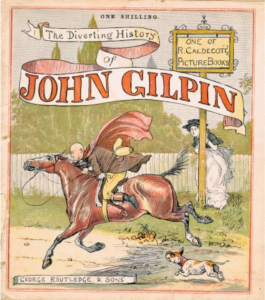
The Caldecott Medal. The Caldecott Medal is named after Randolph Caldecott, a 19th century illustrator from England. In 1878, he illustrated The Diverting History of John Gilpin, a poem by William Cowper (Figure 3.4). Caldecott wasn’t the first illustrator of children’s books, but his work was notable, original, and acclaimed at the time (Figure 3.5).
Figure 3.4. Randolph Caldecott was a prominent illustrator of his time. For example, one of his early books was The Diverting History of John Gilpin by William Cowper and illustrated by Randolph Caldecott, 1878, London, England: George Routledge & Sons. Reprinted with permission from http://www.randolphcaldecott.org.uk/gilpin.htm.Figure 3.5. Did you know that back covers were used by the publisher to advertise other books? Visit the Randolph Caldecott Society website for other details about various editions (http://www.randolphcaldecott.org.uk/editions.htm).
The Caldecott Medal is awarded annually to the artist of the most distinguished American picture book for children published by an American publisher in the United States in English during the preceding year. In the case of the Caldecott, the illustrator wins the award for creating a high-quality visual experience. In particular, the book must be individually distinct and demonstrate eminence across the following criteria (http://www.ala.org/alsc/awardsgrants/bookmedia/caldecottmedal/caldecottterms/caldecottterms):
Excellence of execution in the artistic technique employed;
Excellence of pictorial interpretation of story, theme, or concept;
Appropriateness of style of illustration to the story, theme or concept;
Delineation of plot, theme, characters, setting, mood or information through the pictures;
Excellence of presentation in recognition of a child audience.
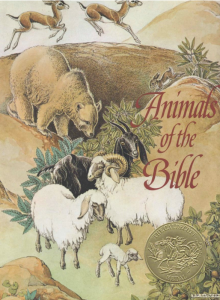
Figure 3.6 The Caldecott Medal was created several years after the Newbery. The first Caldecott was awarded to Animals of the Bible, A Picture Book, illustrated by Dorothy P. Lathrop with text selected by Helen Dean Fish, 1938, New York, NY: Lippincott. Cover art copyright by Dorothy P. LathrThe first Caldecott was awarded in 1938 for Animals of the Bible, A Picture Book, illustrated by Dorothy P. Lathrop with text selected by Helen Dean Fish (Figure 3.6)
The first Caldecott was awarded in 1938 for Animals of the Bible, A Picture Book, illustrated by Dorothy P. Lathrop with text selected by Helen Dean Fish (Figure 3.6).
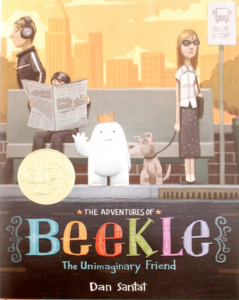
A more contemporary winner was The Adventures of Beekle: The Unimaginary Friend by Dan Santat (Figure 3.7).
The Newbery and Caldecott medals are awarded every year for work published in the previous year. The medal winners and Honor Books (runners up) are adorned with gold or silver medallions on their covers. Libraries, bookstores, and school libraries often create special displays for these books to introduce students to the winners.
Figure 3.7. Artwork and illustrative styles have changed over the years. A more recent Caldecott winner is The Adventures of Beekle: The Unimaginary Friend by Dan Santat, 2014, New York, NY: Little, Brown Books for Young Readers. Copyright 2014 by Dan Santat.
You may have noticed the preachy nature of the early award winners. To combat religious or instructional motives, ALA’s current criteria specifically state that Newbery and Caldecott awards are not for books with didactic intent. In addition, the award specifically guards against popularity as the award committee does not consider sales or the creator’s body of work.
Other Notable ALSC Awards. In addition to the Newbery and Caldecott Medals, the ALSC division of ALA offers seven other prestigious book and media awards to recognize specific populations or in recognition of particular content. I highlighted some of them here:
If a book wins an award, and no one reads it, does it make a noise? Why do you think it became necessary for ALA to focus on authors and illustrators who portray and represent specific populations?
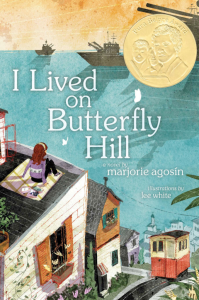
Figure 3.8. The 2015 Pura Belpre Award was given to I Lived on Butterfly Hill by Marjorie Agosín and illustrated by Lee White, 2016, New York, NY: Atheneum Books for Young Readers. Cover art copyright 2014 by Lee White.
The Belpre Medal (Figure 3.8) is awarded to a Latino/Latina writer and illustrator whose work best portrays, affirms, and celebrates the Latino cultural experience in an outstanding work of literature for children and youth (http://www.ala.org/alsc/awardsgrants/bookmedia/belpremedal).
The Geisel Award, named in honor of Dr. Seuss, is awarded to the author(s) and illustrator(s) of the most distinguished American book for beginning readers published in English in the United States during the preceding year (http://www.ala.org/alsc/awardsgrants/bookmedia/geiselaward).
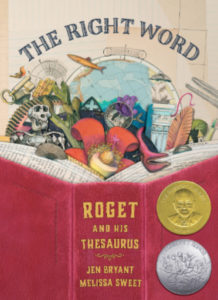
Figure 3.9. The 2015 Sibert Medal was awarded to The Right Word: Roget and His Thesaurus by Jen Bryant and illustrated by Melissa Sweet, 2014, New York, NY: Eerdmans Books for Young Readers. Cover art copyright 2014 by Melissa Sweet.
The Sibert Medal (Figure 3.9) is awarded to the author(s) and illustrator(s) of the most distinguished informational book published in the United States in English during the preceding year (http://www.ala.org/alsc/awardsgrants/bookmedia/sibertmedal).
The Wilder Medal is awarded to the author or illustrator whose books, published in the United States, have made, over a period of years, a substantial and lasting contribution to literature for children (http://www.ala.org/alsc/awardsgrants/bookmedia/wildermedal).
Young Adult Library Services Association (YALSA). The Young Adult Library Services Association is another division of the American Library Association. YALSA is a national association of librarians, library workers and advocates whose mission is to expand and strengthen library services for teens, aged 12-18 (http://www.ala.org/yalsa/aboutyalsa).
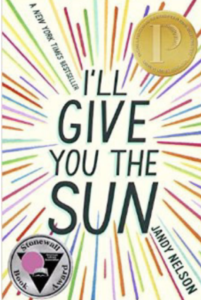
Figure 3.10. The Printz Award is given to young adult literature. A recent winner was I’ll Give You the Sun by Jandy Nelson, 2014, New York, NY: Dial Books. Copyright 2014 by Jandy Nelson.
YALSA administers six book awards for young adult literature. Of these, the Michael L. Printz Award and the Nonfiction Award are considered the most prestigious.
Michael L. Printz Award. Similar to the Newbery, the Printz Award is given to a book that exemplifies literary excellence in young adult literature. A recent Printz Award was given to I’ll Give You the Sun by Jandy Nelson (Figure 3.10).
Nonfiction Award. The YALSA Award for Excellence in Nonfiction is given to the best nonfiction book published for young adults (ages 12-18). One of the latest Nonfiction Awards was given to Popular: Vintage Wisdom for Modern Geek by Maya Van Wagenen.
Ethnic Materials Information Exchange Round Table Task Force (EMIERT). ALA offers 20 Round Table groups which function as a Special Interest Group within the organization. In particular, EMIERT serves as a source of information on recommended ethnic collections, services, and programs.
Why do you think it became necessary for ALA to create a group specifically charged with serving as a source of information on ethnic collections, services, and programs?
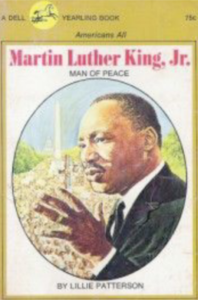
Figure 3.11. The first Coretta Scott King Author Award was given to Martin Luther King, Jr.: Man of Peace by Lillie Patterson, 1969, New York, NY: Dell. Copyright 1969 by Lillie Patterson.
Coretta Scott King Awards. In 1970, EMIERT established the Coretta Scott King Award to recognize outstanding African American authors and illustrators of books for children and young adults that demonstrate an appreciation of African American culture and universal human values (http://www.ala.org/emiert/cskbookawards).
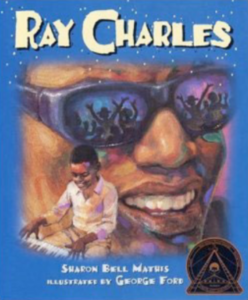
Figure 3.12. The first Coretta Scott King Illustrator Award was given to George Ford for illustrating Ray Charles by Sharon Draper. Ray Charles by Sharon Draper and illustrated by George Ford, 1973, New York, NY: Crowell. Cover art copyright 1973 by George Ford.
The first winner of the Coretta Scott King Author Award was Lillie Patterson for Martin Luther King, Jr.: Man of Peace in 1970 (Figure 3.11). The first illustrator award was presented in 1974 to George Ford who illustrated Ray Charles (written by Sharon Bell Mathis) (Figure 3.12).
A contemporary winner of the author award was brown girl dreaming by Jacqueline Woodson. Christopher Myers recently won the illustrator award for Firebird (written by Misty Copeland).
John Steptoe New Talent Award. John Steptoe, well known for his contributions to children’s literature (Mufaro’s Beautiful Daughters, The Story of Jumping Mouse, Stevie) is the namesake for this award which honors new talent in authorship or illustration.
The first John Steptoe Award was given to Sharon Draper in 1996 for Tears of a Tiger. The first illustrator award was given to Eric Valasquez in 1999 for The Piano Man (written by Debbi Chocolate).
Recent winners include Theodore Taylor III for illustrating When the Beat was Born: DJ Kool Hercand the Creation of Hip Hop and Jason Reynolds for writing When I was the Greatest.
Virginia Hamilton Award for Lifetime Achievement. The lifetime achievement award, named in honor of Virginia Hamilton, is presented in even years to an African American author and/or illustrator of children’s literature. The inaugural winner was Walter Dean Myers in 2010, Ashley Bryan won in 2012, and Patricia and Frederick McKissack won in 2014. Get to know the authors and illustrators who have received the Virginia Hamilton Award for Lifetime Achievement:
By definition, literature scholars focus their attention and analysis on books. Literary scholars have academic homes in many different disciplines, but the fields most closely associated with literary analysis and interpretation are English and the Humanities. However, English and the Humanities were (and in many cases, still are) slow to welcome children’s literature as a serious area of focus. Aren’t Sendak, Blume, and Rowling as crucial to human experience and literary development as Shakespeare, Austin, or Hemingway? Of course! As Francelia Butler (1973) wrote:
To many humanists…in languages, philosophy, psychology, sociology, anthropology, or history, the most embarrassing literature to study is not about autoeroticism or cunnilingus. On such work scholars pride themselves on their broadmindedness. What truly embarrasses them is literature for their own children—‘kiddy lit,’ they call it.” (Butler, 1973, p. 8)
Whoa! The times have changed since 1973. I don’t know about you, but I would be more embarrassed to write about autoeroticsm and cunnilingus than children’s literature. Yikes!
It is true. For some academics, children’s literature does not meet the qualifications to join the world of comparative literatures. Fortunately, there are many gifted scholars who find those views to be outdated and unwarranted. Plus, it is hard to deny the relevance of books that form the basis of a multi-billion dollar industry. In fact, since the 1980’s several universities have developed children’s literature programs to support interest and provide a space for faculty to engage in scholarly pursuit. Programs such as those at the University of Pittsburgh, Ohio State, Kansas State, San Diego State, University of Florida, and the University of North Carolina-Charlotte demonstrate the robust nature of the field.
In spite of varying opinions on the subject, many English and Humanities publications and annual conferences often include articles and papers focused on children’s literature (Neumeyer, 1987; Taylor, 1978). Prestigious organizations, such as the Modern Language Association, have included children’s literature sessions in its annual conference for years.
Children’s literature is too big, too important, and too profitable for writers, scholars, and critics to ignore. Fortunately, over 40 years ago, a group of scholars recognized the value of this body of literature and organized themselves into a collective to systematically explore children’s literature.
Children’s Literature Association (ChLA). This is an association of scholars, critics, professors, students, librarians, teachers and institutions dedicated to the academic study of literature for children. ChLA members define children’s literature as “books, films, and other media created for, or adopted by, children and young adults around the world, past, present, and future” (http://www.childlitassn.org/about).
Of all of the organizations listed in this chapter, ChLA is the only one that exists as a stand-alone association with a sole focus on children’s literature. It also pulls members from different fields and backgrounds.
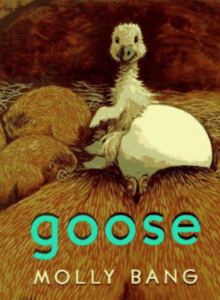
Figure 3.13. Goose by Molly Bang won the Phoenix Award from ChLA. Goose by Molly Band, 1996, New York, NY: Blue Sky Press. Copyright 1996 by Molly Bang.
Phoenix Award and Phoenix Picture Book Award. ChLA recognizes high-quality literature through the Phoenix Award and the Phoenix Picture Book Award. Unlike most awards, which are given to books published in the last year, the ChLA offers their recognition to authors and illustrators whose books did not win a major award during the year of publication. Instead, the awards are given to books published 20 years previously and which have stood the test of time (Phoenix Award http://www.childlitassn.org/phoenix-award; Phoenix Picture Book Award http://www.childlitassn.org/phoenix-picture-book-award).
For example, the 2016 Phoenix Award Winner was Frindle by Andrew Clement. The 2016 Phoenix Picture Book Award Winner was Goose by Molly Bang (Figure 3.13).
In contrast to ALA’s Newbery and Caldecott, the ChLA awards consider quality as well as popularity among a generation of readers in recognizing books that have had an impact on the field.
The Teachers
Closely connected to the study of English is the teaching of English. Therefore, another group of individuals who are invested in the field of children’s literature comprises teachers and teacher educators. Whereas Librarians focus on collecting, cataloguing, and circulating books, and English departments debate the inherent qualities of the texts, the Education scholars focus on the reader’s experience in relation to the text.
Reading literature increases a student’s sensitivity to the power of the written word (Sipe, 2008) while reading picturebooks increases a student’s exposure to visual modes (Brenner, 2011; Sipe, 2011). As such, children’s and young adult literature is the foundation for youth’s literacy development (Short, 2011). Youth need to be familiar with all genres of literature in order to create texts within recognizable written and artistic genres. They also need to know, as captured in picturebooks or graphic novels, how written and artistic modes can reflect their unique experiences and ideas.
In the US, two major literacy organizations provide extensive support, resources, and professional development for teachers—Kindergarten to College. Both of these organizations also give annual recognition to children’s literature texts and they acknowledge authors’ and illustrators’ valuable contributions to children’s literature.
National Council of Teachers of English (NCTE). This organization is “devoted to improving the teaching and learning of English and the language arts at all levels of education” (http://www.ncte.org/mission). NCTE was formed in 1911 “primarily out of protest against overly-specific college entrance requirements and the effects they were having on high school English education” (http://www.ncte.org/history). With such a focus on English education, NCTE has maintained consistent attention to the issues of teaching composition, rhetoric, and literature. Over the years, NCTE’s range expanded to include a focus on teaching “language arts” in the elementary and middle school as well.
To encourage the teaching of English, with particular attention to quality children’s and young adult literature, NCTE offers the following awards for books for children.
NCTE Charlotte Huck Award for Outstanding Fiction for Children. Charlotte Huck was a Professor of Children’s Literature at The Ohio State University. This NCTE award honors her incredible legacy with recognition of an outstanding book of fiction that also has the potential to transform children’s lives by inviting compassion, imagination, and wonder.
O-H-I-O, as a graduate of The Ohio State University, I can attest to the incredible impact of Charlotte Huck’s work, her contributions to the education of teachers of reading and language arts, and the advancement of the field of children’s literature. Her textbook, which is now revised and authored by Barbara Kiefer, is foundational reading for all teachers and anyone with an interest in children’s literature.
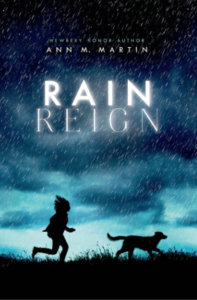
In 2015, the inaugural Charlotte Huck Award was given to Rain Reign written by Ann M. Martin (Figure 3.14).
Figure 3.14. Rain Reign won the inaugural Charlotte Huck Award. Rain Reign by Ann M. Martin, 2014, New York, NY: Feiwel & Friends. Copyright 2014 by Ann M. Martin.
NCTE Orbis Pictus Award for Outstanding Nonfiction for Children. Johannes Amos Comenius was a 17th Century educational philosopher and reformer who wanted to change the ways in which boys learned in school (girls didn’t go to school or really matter at this time). Rather than rote memorization of facts in Latin, Comenius wanted the boys to learn more about the world through active engagement and scholarly pursuit (Comenius, 1896). He published textbooks, such as Janua, which changed instructional methods. His popular textbook, Orbis Pictus (1657), was recognized as the first picturebook schoolbook for children. Therefore, the Orbis Pictus Award is given for excellence in the writing of nonfiction for children.
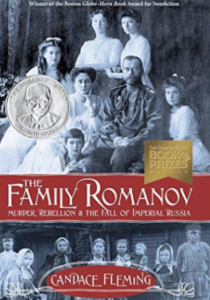
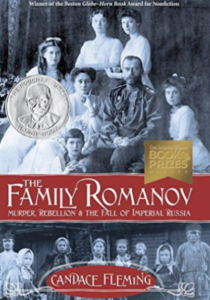
The inaugural winner of the Orbis Pictus Award was Jean Fritz for The Great Little Madison (Figure 3.15). A more recent winner was The Family Romanov: Murder, Rebellion & the Fall of Imperial Russia by Candace Fleming (Figure 3.16).
Figure 3.15. The winner of the first Orbis Pictus Award was The Great Little Madison by Jean Fritz, 1988, New York, NY: Puffin. Copyright 1988 by Jean Fritz.Figure 3.34. A contemporary winner of the Boston Globe-Horn Book Award for Nonfiction is The Family Romanov: Murder, Rebellion & Fall of Imperial Russia by Candace Fleming, 2014, New York, NY: Schwarts & Wade. Copyright 2014 by Candace Fleming.
Similar to the Sibert Medal from ALA (est. 2001), the Orbis Pictus (est. 1989) marked a shift in children’s literature to recognize the aesthetic values of nonfiction and the need for quality writing in information books.
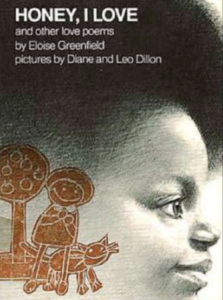
Figure 3.17. Eloise Greenfield is one of my favorite poets of all time. And my favorite Eloise Greenfield book is Honey I Love and Other Love Poems by Eloise Greenfield and illustrated by Diane and Leo Dillon, 1978, New York, NY: HarperCollins. Cover art copyright 1978 by Diane and Leo Dillon.
NCTE Award for Excellence in Poetry for Children. NCTE designates an Award for Excellence in Poetry for Children to honor a living American poet for his or her aggregate work for children ages 3–13. NCTE specifically targeted children’s poetry in an effort to “recognize and foster excellence in children’s poetry by encouraging its publication and by exploring ways to acquaint teachers and children with poetry through such means as publications, programs, and displays” (http://www.ncte.org/awards/poetry). The winners include a “who’s who” of children’s poetry: David McCord (1977 inaugural), Myra Cohn Livingston (1980), Eve Merriam (1981), Valerie Worth (1991), Arnold Adoff (1988), Eloise Greenfield (1997) (Figure 3.17), X.J. Kennedy (2000) and Marilyn Singer (2015).
Children’s Literature Assembly of the National Council of Teachers of English (CLA).The Children’s Literature Assembly is a Special Interest Group of NCTE. This group advocates for the centrality of literature in the classroom, believing that every teacher needs extensive knowledge of children’s and young adult literature. The CLA believes it is a “teacher’s responsibility to help students discover the joy of reading while they also teach students the skills and strategies of fluent reading” (http://www.childrensliteratureassembly.org/index.html).
Each year, the Children’s Literature Assembly committee selects 30 titles for the Notables Award. Books considered for this annual list are works of fiction, non-fiction, and poetry written for children, grades K-8. The books must meet one or more of the following criteria:
Deal explicitly with language, such as plays on words, word origins, or the history of language;
Demonstrate uniqueness in the use of language or style;
This is an interesting award that focuses on a specific type of writing that elicits children’s responses and participation rather than focusing on the identity of the author or the range of the content.
International Literacy Association (ILA). ILA is a “worldwide advocate for excellence in literacy instruction, actively participating in advancing thought leadership for the literacy profession and shaping sound public policy on education” (http://literacyworldwide.org/about-us/where-we-stand).
Founded as the International Reading Association (IRA) in 1956, the organization changed its name in 2015 to reflect a shift from “reading” research toward a broader focus on all aspects of literacy. Yes, “reading” is still a focus of ILA, but the organization also concentrates on writing, speaking, listening, viewing and visual expression. According to the ILA, “Literacy is the ability to identify, understand, interpret, create, compute, and communicate using visual, audible, and digital materials across disciplines and in any context” (http://literacyworldwide.org/why-literacy).
ILA Children’s and Young Adults’ Book Award. These ILA awards are presented to newly published authors who show unusual promise in the children’s and young adults’ book field. Awards are given for fiction and nonfiction published in the previous year and intended for each of three audiences: primary, intermediate, and young adult (http://www.literacyworldwide.org/about-us/awards-grants/ila-children’s-and-young-adults’-book-awards).
The ILA book award focuses on writing targeted at different audiences. Rather than considering literary merit alone, the committee recognizes the developmental differences of readers and offers awards to those who write exceptionally well for different age levels.
Primary Nonfiction:Polar Bears and Penguins: A Compare and Contrast Book. Katharine Hall. 2014. Arbordale Publishing.
Intermediate Fiction:The Night Gardener. Jonathan Auxier. 2014. Amulet Books.
Intermediate Nonfiction:The Industrial Revolution for Kids: The People and Technology That Changed the World. Cheryl Mullenbach. 2014. Chicago Review Press.
Young Adult Fiction:Beauty of the Broken. Tawni Waters. 2014. Simon Pulse.
Young Adult Nonfiction: No award was recommended in 2014.
Children’s Literature and Reading Special Interest Group of the International Literacy Association (CL/R). The mission of the CL/R is to “promote the educational use of children’s books by focusing on recently published children’s literature, supportive professional books, issues relative to children’s literature, and current research findings” (http://www.clrsig.org/nbgs.php). Founded in 1979, CL/R includes members who are teachers, librarians, teacher candidates, administrators, university professors, authors and publishers.
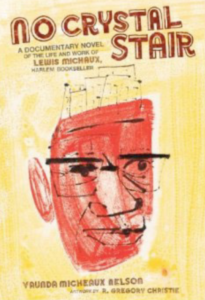
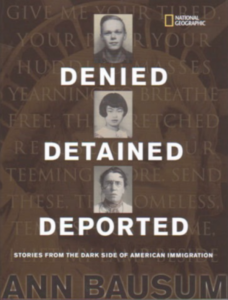
Notable Books for a Global Society (NBGS).In 1995, the CL/R formed the Notable Books for a Global Society Committee to help students, teachers, and families identify books that promote understanding of and appreciation for the world’s full range of diverse cultures and ethnic and racial groups. Each year, the NBGS selects 25 outstanding books for grades K-12 that reflect a pluralistic view of the world (http://clrsig.org/pdfs/2015%20NBGS%20flyer.pdf). The 25 titles represent the committee’s selection of the best in fiction (Figure 3.18), nonfiction (Figure 3.19) and poetry (Figure 3.20). Of primary importance are accuracy and authenticity. The books must accurately and authentically depict people in terms of physical characteristics, social and economic status, intellectual and problem-solving abilities, and displays of leadership and cooperation. The books must also include thought-provoking content that invites reflection, critical analysis, and response. Rather than including a minority group for purposes of tokenism, NBGS books are selected because they provide a richness of detail concerning the group or groups depicted (http://www.clrsig.org/nbgs.php).
Figure 3.18. NBGS books are selected because they accurately portray diverse cultures and groups of people. No Crystal Stair: A Documentary Novel of the Life and Work of Lewis Michaux, a Harlem Bookseller by Vaunda Michaux Nelson and illustrated by R. Gregory Christie, 2012, Minneapolis, MN: Carolrhoda Lab/Lerner. Cover art copyright 2012 by R. Gregory Christie.Figure 3.19. A nonfiction NBGS book is Denied, Detained, Deported: Stories from the Dark Side of Immigration by Ann Bausum, 2009, Washington, D.C: National Geographic. Copyright 2009 by Ann Bausum.Figure 3.20. Poetry books are also included in the NBGS selection process. An example is Dare to Dream…Change the World edited by Jill Corcoran and illustrated by J. Beth Jepson, 2012, Tulsa, OK: Kane/Miller. Cover art copyright 2012 by J. Beth Jepson.
In addition to NCTE and ILA, there are many other organizations whose missions focus on literacy research and who attend to quality in children’s literature texts. However, most of those organizations are for researchers and scholars and they do not offer awards or have sustained initiatives to recognize high-quality books, authors, or illustrators.
The Content Experts
Children’s literature isn’t just about reading and literacy. Children’s literature is also a vehicle for sharing information about the world. Neal deGrasse Tyson (2004) said:
My parents didn’t know much science; in fact, they didn’t know science at all. But they could recognize a science book when they saw it, and they spent a lot of time at bookstores, combing the remainder tables for science books to buy for me. I had one of the biggest libraries of any kid in school, built on books that cost 50 cents or a dollar. (http://www.pbs.org/wgbh/nova/space/conversation-with-neil-tyson.html)
Scholars in the fields of science, social studies, and mathematics have found untapped potential in the form of information books for children. In addition to the nonfiction awards offered by the American Library Association (Sibert Medal) and the National Council of Teachers of English (Orbis Pictus), other professional organizations have created awards to recognize the role of children’s literature in the development of disciplinary knowledge.
The Sibert and Orbis Pictus Medals are awarded to books covering a broad range of topics. Therefore, other organizations created awards to recognize books that represent their specific areas of expertise.
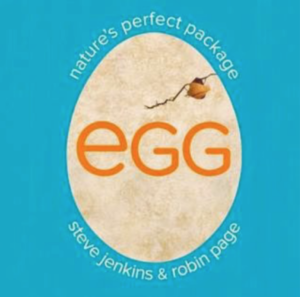
National Science Teachers Association (NSTA). This organization works with the Children’s Book Council (CBC) to create an annual list of Outstanding Science Trade Books for Children. Originally, the list targeted grades K-8 (Figure 3.21), but as the genre of science information texts has developed to include advanced topics (Figure 3.22), the list was expanded to include high school students as well (http://www.nsta.org/publications/ostb/).
Figure 3.21. Science books are recognized by the National Science Teachers Association. Egg: Nature’s Perfect by Robin Page and Steve Jenkins, 2015, New York, NY: Houghton Mifflin Harcourt. Copyright 2015 by Robin Page and Steve Jenkins.Figure 3.22. Advanced science trade books are published for high school students as well. Food Engineering: From Concept to Consumer by Michael Burgan, 2015, Framingham, MA: C. Press/F. Watts Trade. Copyright 2015 by Michael Burgan.
American Phytopathological Society. The American Phytopathological Society created the DeBary Children’s Science Book Award. Selected by scientists in the fields of botony and biological sciences, the awards are presented to the best science books for children. There is a slight bias towards botany and biological science, but books on all topics, from Astronomy to Zoology, are eligible http://www.apsnet.org/edcenter/K-12/Pages/DeBary.aspx.
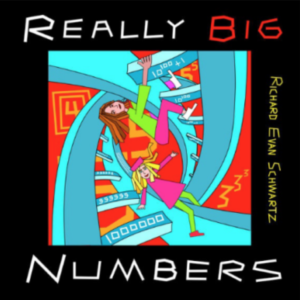
Mathematical Sciences Research Institute. The Mathematical Sciences Research Institute also works with the Children’s Book Council (CBC) to create a list of outstanding mathematics books for children. Identifying winners in five categories, the “Mathical Prize” is awarded to popular, math-related fiction and nonfiction for very young children through
teenagers (http://mathicalbooks.org/). The books are selected if they inspire youth of all ages to cultivate a love of mathematics in the world around them (Figure 3.23). Similar to book awards from NCTE or IRA, the Mathica books are sorted by the intended reader’s age level.
The Mathica Prize comes from math people, not teachers or librarians. The MSRI is primarily funded by the National Science Foundation (NSF) and its mission is the advancement and communication of fundamental knowledge in mathematics and the mathematical sciences.
Figure 3.23 Math books have come a long way. Check out a Mathica winner, Really Big Numbers by Richard Schwarts, 2014, Providence, RI: American Mathematical Society. Copyright 2014 by Richard Schwarts.
National Council for the Social Studies (NCSS). NCSS awards two prizes for outstanding children’s literature. Working with the Children’s Book Council (CBC), NCSS recommends Notable Social Studies Trade Books for Young People. The annual reading list is selected by social studies educators and includes exceptional books for use in social studies classrooms (http://www.socialstudies.org/notable).
NCSS also established the Carter G. Woodson Book Awards for the most distinguished children’s books that depict ethnicity in the United States. First presented in 1974, this award is given to a book written for elementary (K-6) and middle grades (5-8) and it is intended to “encourage the writing, publishing, and dissemination of outstanding social studies books for young readers that treat topics related to ethnic minorities and race relations sensitively and accurately” (http://www.socialstudies.org/awards/woodson/winners).
Content expertise resides in many different places. Many of the aforementioned awards come from professional associations that are focused on teaching disciplinary content (e.g., National Council for the Social Studies, National Science Teachers Association). But others represent the broader discipline. In these cases, the disciplinary concepts or subject matter might take precedence over other important aspects of children’s books, such as the quality of the illustrations or the author’s writing style, but not necessarily so.
The Creators: Children’s Book Writers and Illustrators
You would think, in a book about children’s literature, that I would feature the authors and illustrators as the foremost experts in the field. Truthfully, they are. They create the stuff of which we all obsess (“we” being children’s literature people). They are the ones “doing” while everyone else is “consuming.” But there is no single method for writing children’s books and no single way to illustrate children’s literature. The writers and illustrators are a collection of artists, nomadic thinkers, literary wonderers, and stylistic voyagers who create literature and art differently. Therefore, the creators’ expectations for quality vary. In addition, they come from different backgrounds and schools of practice, leading to the fact that they do not approach the field of children’s literature with one particular point of view.
In the previous sections, I discussed awards for children’s literature that are as much about a targeted agenda as they are about the creators’ products. Similarly, when writers and illustrators get together, they promote their own agendas as well.
Society of Children’s Book Writers and Illustrators (SCBWI). The SCBWI offers five awards for authors in support of their manuscript development and five awards for illustrators to recognize work in progress or illustrators of promise. SCBWI also offers nine awards for those who are already published and whose work is deserving of recognition (http://www.scbwi.org/awards/grants/for-illustrators/).
Several of the SCBWI awards are focused on the business of children’s book creation. For example, the Book Launch Award provides authors and illustrators with recognition and funding to support the promotion of their newly published work and to allow them to “take the marketing strategy into their own creative hands” (http://www.scbwi.org/awards/book-launch-grant/). The Jane Yolen Mid-List Author Grant honors the contribution of mid-list authors and aims to help raise awareness about their current works-in-progress (http://www.scbwi.org/awards/grants/jane-yolen-mid-list-author-grant/). The Spark Award is given to an author or illustrator who self-published a Board Book, Picture Book, Chapter Book, Middle Grade, or Young Adult book through an established self-publishing enterprise or an individually self-published outlet. The Tomie dePaola Award, selected by Tomie himself, is given to an illustrator of promise. The selected illustrator receives $1000 plus tuition and attendance paid to attend the SCBWI winter conference.
In addition to the awards that focus on the professional development of the authors and illustrators of children’s literature, SCBWI also recognizes books for their excellence.
Golden Kite Awards. In contrast to awards given by experts in children’s literature, the Golden Kite Awards are the only children’s literary award judged by a jury of author-and-illustrator peers. The Golden Kite Awards recognize excellence in children’s literature in the following categories: Fiction, Nonfiction, Picture Book Text, and Picture Book Illustration. (http://www.scbwi.org/awards/golden-kite-award/)
Current Golden Kite winners include:
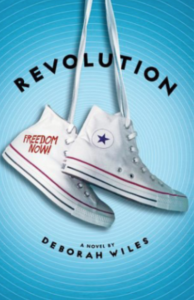
Fiction:Revolution by Deborah Wiles (Figure 3.24);
Nonfiction:The Family Romanov by Candace Fleming;
Picture Book Illustration:The Right Word: Roget and His Thesaurus illustrated by Melissa Sweet and written by Jen Bryant;
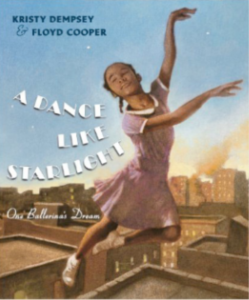
Picture Book Text:A Dance Like Starlight: One Ballerina’s Dream written by Kristy Dempsey and illustrated by Floyd Cooper (Figure 3.25).
Figure 3.24. A Golden Kite Award for Fiction was awarded to Revolution by Deborah Wiles, 2014, New York, NY: Scholastic Press. Copyright 2014 by Deborah Wiles.“Figure 3.25. A Golden Kite Award for Picture Book Text was awarded to A Dance Like Starlight: One Ballerina’s Dream written by Kristy Dempsey and illustrated by Floyd Cooper, 2014, New York, NY: Philomel. Cover art copyright 2014 by Floyd Cooper.
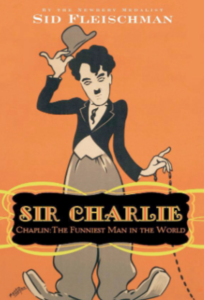
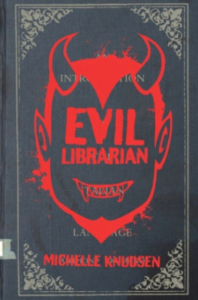
Sid Fleischman Humor Award. Children’s literature is serious business, and much like the Academy Awards for Motion Pictures, the highest acclaim often goes to the dramatic. Humor is difficult to do well; however, humor is often dismissed in favor of profound and deeply emotional work. Therefore, the SCBWI created the Sid Fleischman Humor Award in 2003 to recognize authors whose work exemplifies excellence in writing in the genre of humor. The award is named after its inaugural awardee, Sid Fleischman, author of over 35 books for children (Figure 3.26). Recently, the award went to Michelle Knudsen for Evil Librarian (Figure 3.27).
Figure 3.26. Humor wasn’t often recognized as a literary quality until the Sid Fleischman Humor Award came along. One of Sid Fleischman’s books was Sir Charlie: Chaplin, the Funniest Man in the World by Sid Fleischman, 2010, New York, NY: Greenwillow. Copyright 2010 by Sid Fleischman.Figure 3.27. The Evil Librarian is one example of a humorous book recognized by the Sid Fleischman Humor Award. Evil Librarian by Michelle Knudsen, 2014, Somerville, MA: Candlewick. Copyright 2014 by Michelle Knudsen.
Humor and laughter are emotional responses and always associated with children. It makes sense that high-quality children’s literature should feature humor too. Right?
Society of Illustrators. Founded in 1901, the mission of the Society of Illustrators is “to promote generally the art of illustration and to hold ex-
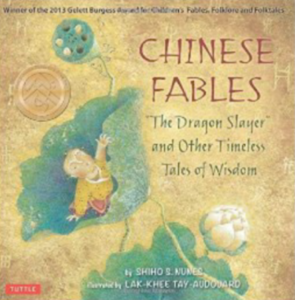
Figure 3.28. The Aesop Prize was awarded to Chinese Fables: The Dragon Slayer and Other Timeless Tales of Wisdom, by Shiho S. Nunes and illustrated by Lak-Khee Tay-Audouard, 2013, Tokyo/Rutland, Vermont: Tuttle Publishing. Cover art copyright 2013 by Lak-Khee Tay-Audouard.
hibitions from time to time.” The Society of Illustrators includes members who are illustrators across various forms including children’s book illustrators, comic book illustrators, and designers. The Society offers juried exhibitions of children’s book art and an annual award for comic and cartoon art (http://www.societyillustrators.org).
Academy of American Poets. The Academy of American Poets was founded in 1934 to foster an appreciation for contemporary poetry and to support American poets through all stages in their careers. The Academy offers prizes, programs, and publishing opportunities for poets. Although the organization is not exclusive to children’s or young adult poetry, they offer programs and support targeted for youth (http://www.poets.org).
American Folklore Society (AFS). This organization is an association of people who study and communicate knowledge about folklore throughout the world. The AFS was founded in 1888 by university-based humanities scholars, museum anthropologists, and private citizens–including author Mark Twain.
Aesop Prize.The Aesop Prize and Aesop Accolades (runners up) are conferred annually by the Children’s Folklore Section of the AFS (Figure 3.28). The award is given to English language books for children and young adults, both fiction and nonfiction. The books must have folklore as central to the book’s content and illustrations (http://www.afsnet.org/?page=aesop).
Science Fiction and Fantasy Writers of America (SFWA). The Society is a professional organization for published authors. It informs, supports, promotes, defends and advocates for its members. Interestingly, SFWA makes loans available to authors who are engaged in writing-related disputes in court.
Norton Award.The SFWA presents the Norton Award to outstanding young adult and middle-grade fiction that includes speculative content, such as science fiction and fantasy (http://www.sfwa.org/nebula-awards/the-andre-norton-award/).
As mentioned throughout this section, authors and illustrators are a collective group of self-employed business owners who have particular needs and agendas. Their organizations tend to focus on the logistics of navigating the publishing industry rather than literary or artistic issues because, quite honestly, they know how to do the literary and artistic stuff. Children and young adults are their targeted audiences, but not the central focus of their organizations.
The Publishers and Booksellers
Speaking of agendas, the motives of the children’s book publishers and booksellers are very clear—sell books. I like to characterize the publishers, and their entourages (sales staff, production staff, editors, etc.), in three ways.
First, there are the sales extremists for whom profit is the bottom line. They sell anything, anywhere. Most of their books are junky, trendy, and sentimental. They are the copy-cats of innovative ideas and the outsourcers of talent. The fact that they sell literature is irrelevant. It’s about profit margins.
Grocery Store Books: “Grocery Store Books” is the term I use for the junky, trendy, sentimental, and cheaply-made books you can find in the check-out line, in a rounder by the deli, or in a display in the magazine aisle.
Next, you have the selective stewards and picky promoters of the children’s literature world—the ones who are passionate about the product, adamant about quality, and savvy in business. They are consumers of children’s literature and admirers of creativity but they know what works and what sells, and they usually go with that.
Finally, you have the creative types—the open-access/not-for-profit/start-up believers who are passionate and idiosyncratic. They work hard and have groundbreaking ideas, and their business is not solely about sales.
As with all of the other awards for children’s literature, you have to understand the motivations of the entity that confers the honor. In the case of publishers and booksellers, it’s ultimately about pushing product.
Horn Book Magazine. Bertha Mahony opened a children’s bookshop, The Bookshop for Boys and Girls, in Boston in 1916. As the proprietor, she implemented innovative ideas such as a traveling bookstore (called The Caravan) (Eddy, 2006). Bertha also authored “Books for Boys and Girls” which was a list of over 1000 titles of recommended books organized by age and subject. This suggestive purchase list eventually turned into a children’s book review service called Horn Book Magazine (http://www.hbook.com/).
Boston Globe-Horn Book Award. The Boston Globe-Horn Book Award is given to outstanding books published in the United States. The books may be written or illustrated by citizens of any country.
In 1967, the inaugural winners were:
Fiction:The Little Fishes by Erik Christian Haugaard (Figure 3.29);
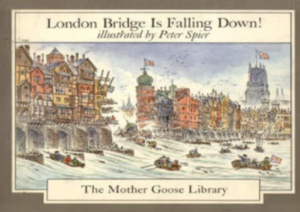
Picture Book:London Bridge is Falling Down by Peter Spier (Figure 3.30).
Figure 3.29. The inaugural Boston Globe-Horn Book Award for fiction was given to The Little Fishes by Erik Christian Haugaard in 1967. The Little Fishes by Erik Christian Haugaard and illustrated by Milton Johnson, 1967, Boston, MA: Houghton Mifflin. Cover art copyright 1967 by Milton Johnson.Figure 3.30. The inaugural Boston Globe-Horn Book Award for Picture Books was given to London Bridge is Falling Down by Peter Spier in 1967. London Bridge is Falling Down by Peter Spier, 1967, London, England: Doubleday and Company, Copyright 1967 by Peter Spier.
I love to compare the early award winners to the most recent ones, especially for an award that spans decades. What do you notice?
In 1976, nonfiction books were added as a separate category and Alfred Tamarin and Shirley Glubok won the award for Voyaging to Cathay: Americans in the China Trade (Figure 3.31).
Figure 3.31. The inaugural Boston Globe-Horn Book Award for Nonfiction was given to Voyaging to Cathay: Americans in the China Trade by Alfred Tamarin and Shirely Glubok, 1976, New York, NY: Viking Press. Copyright 1976 by Alfred Tamarin and Shirley Glubok.
Contemporary winners include:
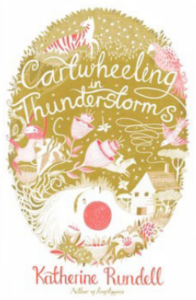
Fiction:Cartwheeling in Thunderstorms by Katherine Rundell (Figure 3.32);
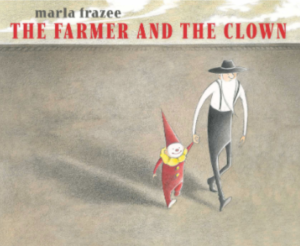
Picture Book:The Farmer and the Clown byMarla Frazee (Figure 3.33);
Nonfiction:The Family Romanov: Murder, Rebellion, and the Fall of Imperial Russia by Candace Fleming (Figure 3.34).
Figure 3.32. A contemporary winner of the Boston Globe-Horn Book Award for Fiction is Cartwheeling in Thunderstorms in Katherine Rundell, 2014, New York, NY: Simon & Schuster. Copyright 2014 by Katherine Rundell.Figure 3.33. A contemporary winner of the Boston Globe-Horn Book Award for Picture Books is a wordless book, The Farmer and the Clown by Marla Frazee, 2014, New York, NY: Beach Lane Books. Copyright 2014 by Marla Frazee.Figure 3.34. A contemporary winner of the Boston Globe-Horn Book Award for Nonfiction is The Family Romanov: Murder, Rebellion & Fall of Imperial Russia by Candace Fleming, 2014, New York, NY: Schwarts & Wade. Copyright 2014 by Candace Fleming.
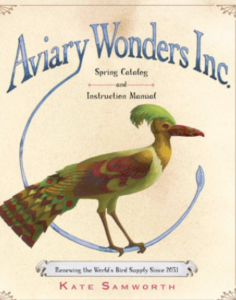
Figure 3.35. The inaugural Kirkus Prize for Young Readers was awarded to Aviary Wonders Inc. Spring Catalog and Instructional Manual by Kate Samwoth.
Kirkus.Kirkus is a literary review magazine founded in 1933 by Virginia Kirkus. Her idea to sell review services to booksellers originated under the threat that she was losing her job during the Great Depression. Virginia was the head of the Department for Boys and Girls at Harper & Brothers Publishers. In her role, she visited booksellers across America to secure sales. It occurred to her that booksellers ordered books from publishing lists without any insight about the book’s quality or style. Virginia decided booksellers needed assistance and she offered her discerning eye. Virginia sold her services (book critiques) to help the booksellers make informed decisions about purchasing.
Whereas Virginia Kirkus delivered her reviews by mail or in person, today, Kirkus Reviews magazine provides industry professionals a preview of the most notable books being published through a weekly email newsletter and on their website (https://www.kirkusreviews.com/). Kirkus also provides other services for authors such as editing and reviews.
The Kirkus Prize. A Kirkus Star is awarded by editors, in consultation with reviewers, to demarcate noteworthy books of excellence. Any of the books that earn a Kirkus Star are eligible to win the yearly prize. The Kirkus Prize is awarded to the best in Fiction, Nonfiction and Young Readers’ Literature.
A writer, a bookseller or librarian, and a Kirkus critic judge each of the three categories. In the Young Readers’ Literature category, the finalists include two picture books, two middle-grade books, and two teen books and one winner is selected among them.
The Kirkus Prize for Young Readers’ Literature was inaugurated in 2014 and given to Aviary Wonders Inc.: Spring Catalog and Instruction Manual written and illustrated by Kate Samworth (Figure 3.35).
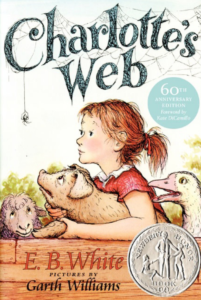
Figure 3.36. E.B. White wrote our most beloved contributions to children’s literature, and the ABA named their read aloud award in honor of his collection of books. Here’s one example, Charlotte’s Web by E.B. White and illustrated by Garth Williams, 1952, New York, NY: HarperCollins. Copyright 1952 by Garth Williams.
American Booksellers Association (ABA). Founded in 1900, the ABA is a national not-for-profit trade organization that works to help independently owned bookstores grow and succeed (http://www.bookweb.org/about-aba). The ABA creates programs; provides education, information, business products, and services; and engages in public policy and industry advocacy.
Indies Choice. The annual Indies Choice Book Awards honor best-loved titles of indie booksellers. ABA member bookstores may vote literature for in eight (8) categories. The Indies Choice Awards recognize the handselling expertise of independent booksellers, and the Book of the Year winners and Honor Award recipients are all titles nominated by ABA member booksellers to the Indie Next Lists.
E.B. White Read-Aloud Awards. These awards were established in 2004 and previously administered by the Association of Booksellers for Children. The award honors books that reflect the read aloud standards that were created by the work of E.B. White in his classic books for children: Charlotte’s Web (Figure 3.36), Stuart Little, and The Trumpet of the Swan. In other words, the books should include playful, well-paced language and have universal appeal.
Parent/child read alouds play an important role in children’s literacy development. Children learn how books work (front to back, left to right, top to bottom), what tells the story/information on each page (text), and how written language sounds (writing and talking are two different things).
Figure 3.37. brown girl dreaming has won many awards, including E.B. White Read-Aloud Award. brown girl dreaming by Jacqueline Woodson, 2014, New York, NY: Penguin. Copyright 2014 by Jacqueline Woodson.
In the first two years of the award, a single book was selected. In 2006, in recognition of the fact that reading aloud is a pleasure at any age, the award was expanded into two categories: Picture Books, and Older Readers (http://www.bookweb.org/general-marketing-resources). In addition to honoring current titles, the E.B. White Award also inducts books into its Hall of Fame, and this list is a great resource for finding old favorites.
The E.B. White Award was recently awarded to:
Middle Reader: brown girl dreaming, by Jacqueline Woodson (Figure 3.37);
Picture Book: Sam and Dave Dig a Hole, by Mac Barnett, Jon Klassen;
The Hall of Fame inductees include:
Blueberries for Sal, by Robert McCloskey;
Frog and Toad, by Arnold Lobel (Video 3.1);
If You Give a Mouse a Cookie written by Laura Numeroff and illustrated by Felicia Bond.
Children’s Book Council (CBC). This is the nonprofit trade association of children’s book publishers in North America. The Children’s Book Council came into being as an organizing structure to manage activities associated with Children’s Book Week, activities that were originally managed by Anne Carroll Moore and Alice Jordan, the supervisors of children’s services in the New York and Boston public libraries in 1919 (Eddy, 2006). Over time, the Children’s Book Council developed into an organization that advocates for the children’s publishing industry through educational programming, professional development, marketing and promotion.
This is where the history of the library has relevance to today.
In joint sponsorship with the International Literacy Association, the Children’s Book Council administers the Choice Book Awards. According to the CBC website,
Teams of ILA-affiliated educators in five geographic regions receive copies of each submitted title to provide to students to read and rate in classrooms across their region. The votes from the five regions (from approximately 12,500 children) are compiled and the five titles with the highest number of votes in each category (K-2, 3-4, 5-6) become the finalists for the Children’s Choice Book Awards.
Teen Book of the Year finalists are chosen by 4,000+ teens via voting conducted by Teenreads.com.
The five finalists in each of the Children’s Choice Debut Author, Teen Choice Debut Author and Children’s Choice Illustrator categories are determined by two selection committees comprised of librarians, educators, booksellers, and children’s literature experts appointed by Every Child a Reader (http://ccbookawards.com/about.php).
Children’s Choice Book Award. The Children’s Choice Book Award is given to a “book of the year” for K-2, 3-4, and 5-6 grades following the procedures outlined above.
Teen Choice Book Award.The Teen Choice Award is given to a young adult “book of the year” following the procedures outlined above.
Although The Children’s & Teen Choice Book Awards promote themselves as “the only national book awards program where the winning titles are selected by children and teens,” this proclamation is skewed by the intervention of the International Literacy Association and Children’s Book Council members who select the books to be voted upon and who make the final choices for some of the awards. For unfiltered reviews from children and teens, one must look elsewhere. In addition, to eliminate the influence of big publishing, one must take a look at small publishing houses and self-published authors and illustrators.
The Fans
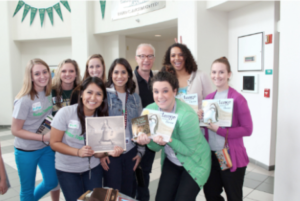
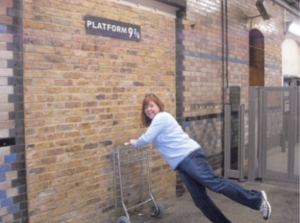
Seriously, the fans are experts? Yes, the fans are experts. The people (children, teens, and adults) who stand in line for book signings (Figure 3.38), attend lectures, follow authors and illustrators on Twitter, and wear book-themed clothing—they are experts? Yes, the fans are experts. The people who use children’s literature quotes in their email signatures, dress up like book characters for Halloween, take children’s-literature-themed vacations (Figure 3.39), and populate numerous Pinterest pages with the “best of” guide to some (fill-in-the-blank) sub-genre of children’s literature—they know how to judge quality. Yep. Experts.
Figure 3.38. Book fans meet Henry Cole at the USF CLICK Conference (Children’s Literature Collection of Know How). Photo copyright 2015 by Jenifer Schneider.Figure 3.39. Yes, I flew through platform 9 ¾ in London’s Kings Cross Station. Photo copyright 2015 by Troy Schneider.
The people who obsess about children’s literature—the avid readers, booksellers, beach goers, grad students, individual teachers and librarians, and all others who have a passion for children’s and young adult literature—know more about books, authors, trends, and literary events than most scholars or critics I’ve ever met or read. Why? Fans are passionate, not posturing. They study deeply and broadly. And they share their responses freely; they are open-access.
Unlike other awards that are predominantly managed and/or filtered by the publishers via preview copies and marketing campaigns, the fans vote with their purchases, lending records, fanfiction tributes, and other networked methods. However, unlike other groups of experts, the fans are harder to organize. There are book clubs, fan clubs, and individual bloggers, but it is difficult to pull these distinct entities together; albeit, some have tried.
Cybils. The Cybils are the Children’s and Young Adult Bloggers’ Literary Award. In other words, the Cybils are an organizing entity for independent book bloggers. Cybils judges are a group of selected bloggers who “read, discuss, think about, blog about, narrow down, and select the year’s best (and most kid-friendly) books (http://www.cybils.com/information-for-bloggers/judging-overview).”
According to their website, “The Cybils Awards aims to recognize the children’s and young adult authors and illustrators whose books combine the highest literary merit and popular appeal. If some la-di-dah awards can be compared to brussels sprouts, and other, more populist ones to gummy bears, we’re thinking more like organic chicken nuggets. We are yummy and nutritious” (http://www.cybils.com/about-the-cybils-awards).
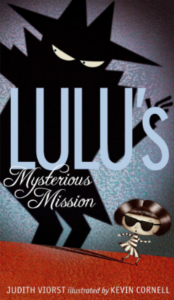
The Cybils began in 2006 and the awards continue today, covering a range of children’s literature: best book app (Figure 3.40), fiction picture book, non-fiction, easy reader (Figure 3.41), early chapter book, graphic novel, poetry, middle grade fiction, and speculative fiction.
Figure 3.40. The Cyblis selected Kalley’s Machine Plus Cats as the best book app of 2015 (https://itunes.apple.com/us/app/kalleys-machine-plus-cats/id905722643?mt=8&ign-mpt=uo%3D4). Kalley’s Machine Plus Cats by Jon, Carrie, Corbett, & Kalley Alexander, 2014, RocketWagon: Retrieved from http://rocketwagon.com/app/kalleys-machine/.Figure 3.41. You don’t see many awards for easy readers or early chapter books. The Cybils categorizes their awards based on ages and stages in reading development. A Cyblis Early Chapter Book winner was Lulu’s Mysterious Mission by Judith Viorst and illustrated by Kevin Cornell, 2014, New York, NY: Atheneum. Cover art copyright 2014 by Kevin Cornell.
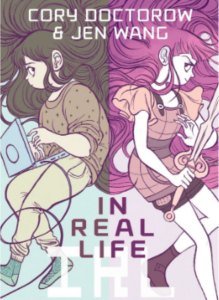
The Cybils are also awarded to a range of young adult literature: fiction, graphic novel (Figure 3.42), non-fiction, speculative fiction.
Graphic Novels are popular with readers and gaining lots of attention from publishers and award committees as well.
For example, First Second books (http://www.firstsecondbooks.com/) publishes and blogs about graphic novels. Their website includes an award list as well.
Figure 3.42. The Cybils also gives awards to graphic novels for children and young adults. A recent winner was In Real Life by Cory Doctorow and Jen Wang, 2014, New York, NY: First Second. Copyright by Cory Doctorow and Jen Wang
Children’s Choices—Revisited. Children’s Choices is a program initiated by the International Literacy Association and Children’s Book Council in 1974. Each year, children choose favorite books among the approximately 500 titles donated by children’s book publishers. Team Leaders from five different areas around the US distribute the books and collect responses. Each year, thousands of children participate in the voting and review experience. The Children’s Choices are organized by reading level and published as an expansive list (http://www.cbcbooks.org/wp-content/uploads/2013/04/childrenschoiceslist_2015.pdf).
Children’s Choices is marketed as a list created by children. However, the children choose from a predetermined list and the results are clearly marketed to teachers. Although there are enough titles (about 500) to allow for variation and to get a sense of children’s preferences, Children’s Choices is a list of books aggregated within boundaries. According to Beach (2015), there is a significant divergence between the providers and consumers of children’s literature. Beach compared the lists from ALA’s Notable Children’s Books (chosen by a committee of librarians) and the ILA’s Children’s Choices (chosen by children) from 1974 until 2004. He found that there was only a 4.36% overlap between the lists across the 30-year period. In fact, he also noted that the award winning books that were prominent on the adult list seldom appeared on the children’s list. So much for awards, right?
If children choose within a predetermined list, are we really getting a sense of their choices?
Other Indicators of Importance
I have presented my opinion of the experts in the field of children’s literature and described the awards they offer to recognize and reward quality. Why? Experts are important. They challenge, guide, and direct the field. They spark excellence. Beyond personal preferences (which, of course, they possess), they have a sense of the history and trends of the field and they can compare books as well as creators’ contributions. But sometimes experts are wrong (see the Phoenix award). And sometimes experts are right. And sometimes experts are right, but no one listens.
Popularity and Sales
Oftentimes it’s not the inherent qualities of a book that determine its excellence; it is the book’s commercial success. Metrics, such as the New York Times Best Sellers List or Amazon Best Sellers often dictate which books are created, marketed, and sold.
Many people think that the New York Times list has a mechanism to measure sales. The reality is they aggregate sales numbers based on self-report from the vendors.
The sales venues for print books include independent book retailers; national, regional and local chains; online and multimedia entertainment retailers; supermarkets, university, gift and discount department stores; and newsstands. E-book rankings reflect sales from leading online vendors of e-books in a variety of popular e-reader formats…. The universe of print book dealers is well established, and sales of print titles are statistically weighted to represent all outlets nationwide. The universe of e-book publishers and vendors is rapidly emerging, and until the industry is settled sales of e-books will not be weighted.
Among the categories not actively tracked at this time are: perennial sellers, required classroom reading, textbooks, reference and test preparation guides, journals, workbooks, calorie counters, shopping guides, comics, crossword puzzles and self-published books.
Interesting! E-books are included, but they aren’t weighted because the industry isn’t predictable or controlled—yet.
In addition, the New York Times documents when bookstores report that a book has been ordered in bulk. Bulk orders can happen for a variety of reasons. For example, in the State of Florida, the Sunshine State Young Readers program is a reading motivation program for students in grades 3-8. If the Sunshine readers are required summer reading, libraries and bookstores might order the books in bulk.
Amazon Best Sellers. Amazon ranks 100 books based on sales from their website. Unlike the New York Times list, which provides a singular ranking based on sales for the week, Amazon updates the best sellers hourly. In addition, Amazon provides an overall best sellers list of children’s books, but they also provide the opportunity to look for best sellers by category (e.g., art, biographies, political, science, sports, women, etc. (http://www.amazon.com/Best-Sellers-Books-Childrens/zgbs/books/4)
Bestseller lists offer consumers an opportunity to monitor trends and make purchases with the idea that books are popular and well-received by children.
Sometimes popularity indices are correct (e.g. the Harry Potter series), and sometimes they are wrong, because children don’t buy books; parents do. For example, when Dr. Seuss’ lost book, What Pet Should I Get, was set for publication (7-28-2015), Amazon started taking orders and the book was listed as the #1 best seller for weeks prior to its release. Not a single child had read the book at that point.
Remember, children don’t typically buy books on the Internet; adults do. You should view “bestsellers” as adult purchases, not necessarily children’s choices.
When it comes to popularity and sales, celebrities such as Jamie Lee Curtis (actress), Julie Andrews (actress), or Madonna (singer) write books, their books tend to skyrocket to the top of the New York Times and Amazon bestsellers lists. Why? Parents and grandparents buy the books.
Social Networks
For a more accurate indicator of children and young adults preferences, I use natural resources—I talk to kids.
Since I can’t talk to kids all over the world, I also use digital resources such as Twitter. In the world of children’s literature, Keith Richards (guitarist for the Rolling Stones), Bob Dylan (singer/songwriter), and Bruce Springsteen (singer/songwriter) have written books for children, but they are not rock stars. The rock stars of children’s and young adult literature are J.K. Rowling (4.29 million), John Green (4.28 million), and Neil Gaiman (2.18 million) who have millions of followers on Twitter.
Here are some suggestions for following illustrators of children’s books.
Find Information Through Author & Illustrator Websites – Search the professional Society of Children’s Books Writers and Illustrators: http://www.scbwi.org/
In addition, recommendation sites, such as Goodreads (www.goodreads.com), offer reader ratings and feedback on books. The sites query a reader’s book preferences and then use algorithms to determine which books are likely favorites. Sites such as Goodreads also allow members to create their own lists of favorites that can appear in diverse categories such as best books about animals, best books about sports, or popular books about trains. The categories are almost endless.
Whereas Twitter or Goodreads may serve as a more accurate indicator of author or illustrator popularity, if you want to know about particular books, youth tend to leverage their “buying” power at the library.
Circulation Reports
Libraries, without a financial stake in any particular book’s success, offer circulation reports for an accurate assessment of children’s and young adult preferences. Resources, such as the Library and Book Trade Almanac (2015) provide statistical data and other information to determine trends. Although the almanac is expensive, librarians use the data to make purchases for their collections. Similar resources are available for school libraries as well.
The Lists
For an encompassing list of lists, the Junior Library Guild has compiled extensive resources to help you navigate the following:
Children’s literature awards, especially the Newbery and Caldecott Medals, have a long and important history. These awards have clearly elevated children’s literature as Art and Literature. But along the way, librarians, scholars, readers, authors and illustrators began to notice a few trends…
The Caldecott is awarded to far more men than women.
The Newbery is awarded to Caucasian authors more than any other racial group.
The Newbery and Caldecott books predominantly feature Caucasian characters who are mostly male.
The Orbis Pictus winners feature limited portrayals of people from diverse backgrounds, with different religions, who represent different developmental abilities, and who represent a range of sexual identities (Crisp, 2015).
Remember the history of the library? Many libraries and schools were segregated until the 1960’s. How can children dream of growing up to write or illustrate children’s books, if quality books were not part of their lives? It takes generations to recover from institutional racism, and just because a law is passed doesn’t mean the changed happen immediately. Look at Obamacare. Look at marriage equality.
According to the ALA, when the Newbery Medal was approved in 1922, its purpose was as follows: “To encourage original creative work in the field of books for children. To emphasize to the public that contributions to the literature for children deserve similar recognition to poetry, plays, or novels. To give those librarians, who make it their life work to serve children’s reading interests, an opportunity to encourage good writing in this field” (http://www.ala.org/alsc/awardsgrants/bookmedia/newberymedal/aboutnewbery/aboutnewbery).
Yet, in 1922, good writing focused on the White, middle- or upper-class experience. Children from different races, ethnicities, and religious backgrounds did not see themselves in books. Similarly, nonfiction texts have not evolved to reflect diverse perspectives on history, science, technology and our encounters with the world. As Crisp (2015) wrote: “It is discouraging that… the world of nonfiction texts continues a long-standing tradition of excluding minority populations from children’s media and other artifacts of popular culture” (p. 253).
The Dangers of a Single Story
Watch Chimamanda Adichie’s story about books and her childhood (Video 3.2).
Rudine Sims-Bishop, a literacy professor and children’s literature expert, wrote: “Literature transforms human experience and reflects it back to us, and in that reflection we can see our own lives and experiences as part of the larger human experience. Reading, then, becomes a means of self-affirmation, and readers often seek their mirrors in books.” (Bishop, 1990 p. ix)
For this reason, calls for diverse portrayals and different perspectives have consistently remained since the early days of the library. Throughout the 20th century, many individuals and groups called for better literature featuring diverse populations. Some of the calls were heard, especially in the 1990’s, but the problem remains.
Two noted children’s authors, Christopher Myers (2014) and Walter Dean Myers (2014), clearly identified the continuance of this problem and its consistent effects on generations of readers. Of the “apartheid” of children’s literature, and the lack of characters of color in books, Christopher Myers noted that today’s children don’t view literature as a mirror, but more as a map. In limiting their view of what’s possible for others, “children of color remain outside the boundaries of imagination,” following a “flawed cartography” of limited possibilities for their lives. Similarly, Walter Dean Myers wrote of his own experiences and limitations in a world in which people’s views of himself and others were limited by their lack of experiences with people of color. Books, he believes, can change perceptions. He wrote,
Books transmit values. They explore our common humanity. What is the message when some children are not represented in those books? Where are the future white personnel managers going to get their ideas of people of color? Where are the future white loan officers and future white politicians going to get their knowledge of people of color? Where are black children going to get a sense of who they are and what they can be?
If we can’t physically interact with different people in our own lives, books have the potential to give us the vicarious experiences that change minds. Books shape and shift our identities.
More Awards and Different Labels
To combat the dangers of privileging certain voices and books, other awards and honors have been created to highlight diverse perspectives. Yet these awards are also criticized for being overly myopic.
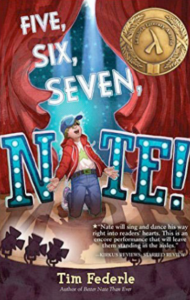
Lambda Literary Award (http://www.lambdaliterary.org/awards/guidelines.html). The Lammy’s identify and celebrate the best lesbian, gay, bisexual and transgender books of the year and affirm that LGBTQ stories are part of the literature of the world. Most of the Lammy’s identify quality books in adult literature categories, but there is one Lammy award given for children’s and young adult literature (Figure 3.43). Individual works and collections of fiction, nonfiction, picture books, and poetry whose intended audience is young readers are all eligible; anthologies are not eligible (see more at http://www.lambdaliterary.org/overview-of-llf-awards/#sthash.SRoSH1N6.dpuf).
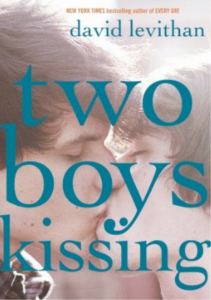
The Lammy is typically awarded to one book, representing all categories of fiction, nonfiction, picture books, and poetry. Occasionally, the committee selects more than one book. For example, in 2014, two novels won a Lammy (Figure 3.44 and Figure 3.45).
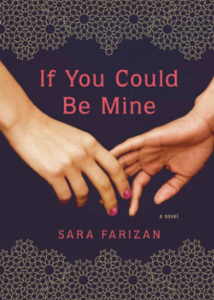
Figure 3.43. The 2015 Lammy was awarded to Five, Six, Seven, Nate! by Tim Federle, 2015, New York, NY: Simon & Schuster Books for Young Readers. Copyright 2015 by Tim Federle.Figure 3.44. The novel, Two Boys Kissing, won a Lammy for fiction in 2014. Two Boys Kissing by David Levithan, 2013, New York, NY: Alfred A. Knopf Books for Young Readers. Copyright 2013 by David Levithan.Figure 3.45. The novel, If You Could Be Mine, also won a Lammy in 2014. If You Could Be Mine by Sara Farizan, 2013, New York, NY: Algonquin Books. Copyright 2013 by Sara Farizan.
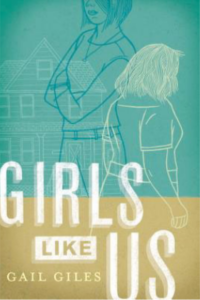
Figure 3.46. An award that focuses on the portrayal of disability is the Schneider Family Book Award. Girls Like Us by Gail Giles, 2014, Somerville, MA: Candlewick Press. Copyright 2014 by Gail Giles.
Notable Books for a Global Society (http://clrsig.org/nbgs.php). The Children’s Literature & Reading Special Interest Group of the International Literacy Association selects 25 outstanding trade books for enhancing student understanding of people and cultures throughout the world.
Schneider Family Book Award (American Library Association) (http://www.ala.org/Template.cfm?Section=bookmediaawards&template=/ContentManagement/ContentDisplay.cfm&ContentID=172663#). The award honors an author or illustrator for a book that embodies an artistic expression of the disability experience for child and adolescent audiences (Figure 3.46). The book must portray some aspect of living with a disability or that of a friend or family member, whether the disability is physical, mental or emotional. The award is given to a teen book, a middle school book, and a children’s book.
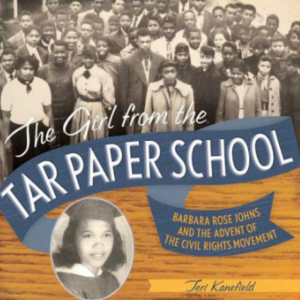
Figure 3.47. A recent Jane Addams Children’s Book Award was given to The Girl from the Tar Paper School: Barbara Rose Johns and the advent of the Civil Rights Movement by Teri Kanefield, 2014, New York, NY: Abrams Books for Young Readers. Copyright 2014 by Teri Kanefield.
Jane Addams Children’s Book Award (http://www.janeaddamspeace.org/jacba/). The award is given to children’s books that effectively promote the cause of peace, social justice, world community, and the equality of the sexes and all races as well as meeting conventional standards for excellence (Figure 3.47).
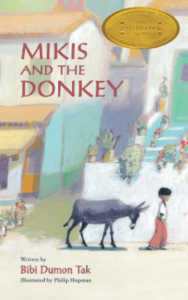
Figure 3.48. The Batchelder Award goes to a publisher. Eerdmans Books won the 2015 award for Mikis and the Donkey, written by Bibi Dumon Tak, illustrated by Philip Hopman, translated by Laura Watkinson, 2014, Grand Rapids, MI: Eerdmans Books. Copyright 2014 by Philip Hopman.
Mildred L. Batchelder Award (American Library Association) (http://www.ala.org/awardsgrants/mildred-l-batchelder-award). This citation is given to an American publisher for the most outstanding children’s book originally published in a foreign language in a foreign country, and subsequently translated into English and published in the United States (Figure 3.48).
Valerie Knight, a reference librarian at Wayne State College maintains an excellent LibGuide of Children’s Award Winning Books. She updates the lists with the newest winners and provides short summaries of the books (http://libguides.wsc.edu/content.php?pid=404952&sid=3899399).
Whose Story? Additional Considerations
Sometimes awards and recognition are important because they give voice to the voiceless and recognition to the unrecognized. Some awards have provided inspiration to authors and illustrators, drawing their attention, and with it, more diverse portrayals in books.
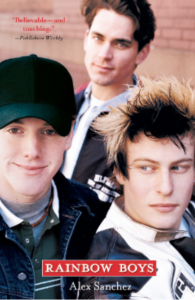
Figure 3.49. Thomas Crisp wrote about the impact of reading Rainbow Boys. Rainbow Boys by Alex Sanchez, 2003, New York, NY: Simon & Schuster Books for Young Readers. Copyright 2003 by Alex Sanchez.
In addition, “more” portrayals are not necessarily desirable portrayals. In his article, “It’s Not the Book, It’s Not the Author, It’s the Award,” Thomas Crisp (2011) recounts his experience reading his first young adult novel featuring a gay main character (Figure 3.49). Overwhelmed with emotion, it was important to Thomas that the author was also gay. For reasons he described in his article, his reading became more authentic when the author shared the same gay, male identity as the main character, and the same identity as Thomas. Therefore, when the Lammy’s were criticized for limiting their selection criteria to LGBT authors, Thomas supported their decision although he recognized the move as contrary to the nature of vicarious reading and writing experiences in which imagination and creativity are the focus. In this instance, Thomas’ feelings were not about the importance of books or the authors who write them. Instead, Thomas wanted recognition for LGBT people who have been systematically persecuted. He wanted LGBT people to have the award.
Even though awards and labels were developed with the intention of creating opportunity structures and recognition for many people’s stories, debates continue.
Here is a selection of articles and blogs on the subject:
Figure 3.50. Gary Paulsen, a White man, wrote Nightjohn, a story about a Black slave. Nightjohn by Gary Paulsen and illustrated by Jerry Pinkney, 1993 by Jerry Pinkney.
Among the most powerful of Paulsen’s works (Hatchet; The Winter Room; Dogsong), this impeccably researched novel sheds light on cruel truths in American history as it traces the experiences of a 12-year-old slave girl in the 1850s. Narrator Sarny exposes the abuse (routine beatings, bondage, dog attacks, forced “breeding”) suffered by her people on the Waller plantation. The punishment for learning to read and write, she knows, is a bloody one, but when new slave Nightjohn offers to teach her the alphabet, Sarny readily agrees. Her decision causes pain for others as well as for herself, yet, inspired by the bravery of Nightjohn, who has given up a chance for freedom in order to educate slaves, Sarny continues her studies. Convincingly written in dialect, this graphic depiction of slavery evokes shame for this country’s forefathers and sorrow for the victims of their inhumanity. (http://www.publishersweekly.com/978-0-385-30838-0)
Nightjohn (Figure 3.50) is a story about two Black slaves written by a White man (Gary Paulsen). The main character is Nightjohn, a Black, male adult. The other main character is Sarny, a Black, female girl. Gary Paulsen wrote Nightjohn from Sarny’s perspective using African American English (AAE).
According to a book review, Paulsen succeeded in presenting the story.
Happy to be Nappy (Figure 3.51) is a concept book about Black girls’ kinky hair and all of the ways nappy hair can be worn and styled. Happy to be Nappy is written by a Black woman. Not only is Happy to be Nappy written by a Black woman, but it’s written by bell hooks, one of the most acclaimed Black, Feminist, cultural theorists of our time.
This joyous ode to hair may well restart conversations that began last year with the controversy over Carolivia Herron’s Nappy Hair. Bubbling over with affection, and injecting a strong self-esteem boost for girls, hooks’s ebullient, poetic text celebrates the innate beauty and freedom of hair that’s “soft like cotton,/ flower petal billowy soft, full of frizz and fuzz.” Waxing poetic about “short tight naps” or “plaited strands all,” hooks conjures all the lovely varieties of hairstyles that “let girls go running free.” She sings the praises of “girlpie hair,” subtly reinforcing her theme with a chorus of descriptive words like “halo” and “crown.” She also evokes the intimate warmth of mother-daughter time–”sitting still for hands to brush or braid and make the day start hopefully.” A powerful, uplifting and, above all, buoyantly fun read-aloud, the text receives a superb visual interpretation by Raschka (Like Likes Like)… (http://www.publishersweekly.com/978-0-7868-0427-6)
Figure 3.51. bell hooks, a Black woman, wrote Happy to be Nappy, a book about girls’ hair. Happy to be Nappy by bell hooks and illustrated by Chris Raschka, 1999, New York, NY: Jump at the Sun. Cover art copyright by Chris Raschka.
On the other hand, aren’t these works of fiction? Who is to say that a White man can’t understand the emotions of slavery or the dialect of the times given the proper research? Isn’t it possible that experiences in Paulsen’s own life, the language of his own family, might be very similar to those of Nightjohn? Wouldn’t his ability to create believable characters demonstrate his ability to write? bell hooks has short hair. I can’t tell if it’s nappy or kinky, but who is to say she experienced the rituals she wrote about in her book?
What about the illustrations? Do the same arguments hold true? Should Black people only draw Blacks and White people only draw Whites? Who gets to draw animals and aliens?
Among the most powerful of Paulsen’s works (Hatchet; The Winter Room; Dogsong), this impeccably researched novel sheds light on cruel truths in American history as it traces the experiences of a 12-year-old slave girl in the 1850s. Narrator Sarny exposes the abuse (routine beatings, bondage, dog attacks, forced “breeding”) suffered by her people on the Waller plantation. The punishment for learning to read and write, she knows, is a bloody one, but when new slave Nightjohn offers to teach her the alphabet, Sarny readily agrees. Her decision causes pain for others as well as for herself, yet, inspired by the bravery of Nightjohn, who has given up a chance for freedom in order to educate slaves, Sarny continues her studies. Convincingly written in dialect, this graphic depiction of slavery evokes shame for this country’s forefathers and sorrow for the victims of their inhumanity. (http://www.publishersweekly.com/978-0-385-30838-0)