Chapter 7: Early Childhood Books
Introduction
This chapter was written by Jenifer Jasinski Schneider in 2016, the author of an OER entitled, The inside, outside, and upside downs of children’s literature: From poets and pop-ups to princesses and porridge. The authors of A Guide to Children’s Literature received permission to use original content from this OER.
Main Content
Babies
“Babies can’t read.” This statement is true only if you have a very formal, school-based conception of reading. Babies don’t go to school or sit at desks; therefore, don’t expect them to read the same way a 6-year-old reads (Figure 7.1). Instead, newborn babies experience reading (Video 7.1 Reading to a Newborn).
Video 7.1: Reading to a Newborn. http://www.kaltura.com/tiny/m3fdp
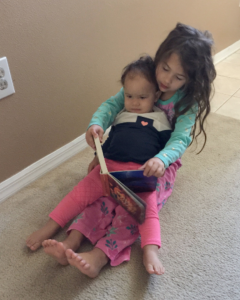
Babies exhibit emergent reading behaviors when they have access to books. In other words, little babies read with their eyes, their hands, and their body language (Figure 7.2). Older babies learn how to hold books, turn the pages, and follow along (Figure 7.3). Parents, family members, teachers, and caregivers who recognize and encourage these behaviors (Figure 7.4) can significantly effect a child’s attitude toward reading, can help a child develop the persistence necessary to be receptive to later reading instruction, can help a child develop higher-level thinking skills, can increase a child’s language proficiency, and can help a child acquire basic academic knowledge (Gregory and Morrison, 1998; High et.al., 2014).
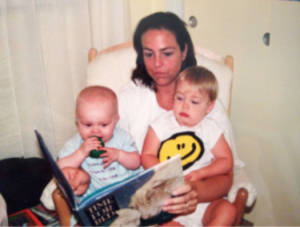
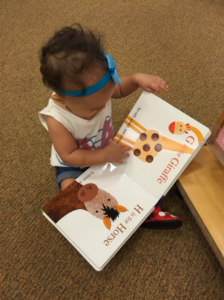
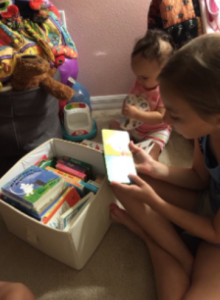
The key figure in baby reading is the adult who recognizes early reading behaviors and encourages them, not discourages them (Video 7.2 Reading to a Baby).
Babies will gnaw on books. That’s ok; babies explore the world with their mouths. That’s why publishers make baby books. As a parent, I used all forms of baby books, depending on where I was going.
Short List of Recommendations for Babies:
- Soft books for teething time. Soft books are great for quiet places like church or doctor’s waiting rooms. Soft books work well for the car seat or in restaurants (Figure 7.5). On a personal note, I loved soft books because my older daughter spit up a lot. Soft books are washable!
- Waterproof books for bath time (also good for the babies who spit up a lot). But they will get moldy inside, so squeeze and sniff for smelly funk.
- Touch and feel books for bedtime.
- Board books for the stroller.
- Baby books are great because they are small,the pictures and text match, the images are clear, and babies can hold them.
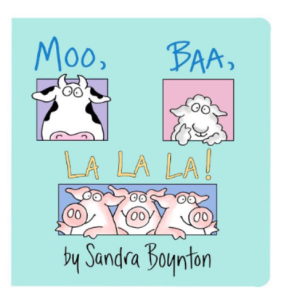
- Sandra Boynton has wonderful board books (Figure 7.6).
- I love anything with Sesame Street characters. Sesame Street publishes lots of board books.
- But babies also need bigger books with more elaborate language and pictures. It’s ok if the babies can’t “read” them. They will “read” them in their own way by looking, touching, and licking.
- When babies are read to, and someone turns the pages and guides their attention, babies will learn to look at the pictures, follow the pages, and hear the language (which is different than talking).

Toddlers
As babies grow into toddlers, they will develop a general sense of how books work if they see how books work. That is, they learn that books are read from front to back, top to bottom, and left to right. Adults have to show them how (Video 7.3 Reading with a Toddler).
Video 7.3: Reading with a Toddler http://www.kaltura.com/tiny/mg2he
When toddlers read books with their parents, they learn that squiggly black lines (text) carry the messages on each page, telling the reader what to say. It’s an amazing phenomenon to toddlers, and they will ask for the same book over and over and over again. When children ask for the same book, just read it. I know it’s annoying, but get over it. Here’s why.
-
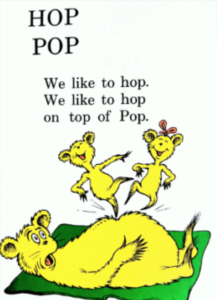
Figure 7.7. Dr. Seuss’ Beginner Books have repetitive, rhyming language that is easy for toddlers to memorize. Excerpt from Hop on Pop by Dr. Seuss, 1963, New York, NY: Random House. Copyright renewed 1991 by Dr. Seuss Enterprises L.P. If adults read the same book over and over again, toddlers learn that the message stays exactly the same every single time. In other words, print has lasting power.
- Think about how comforting that may seem to a toddler. In a world full of information and different experiences every day, sameness and routine are comforting.
- When a toddler hears the same book over and over again, he or she is matching the spoken words to the text. The child will start to remember the story and the words.
- This is when many parents will say, “She’s not really reading.” Trust me, she is reading. When she says dada, she’s talking, right?
- Reading the same book helps the child gain a sense of story and begin to understand the structure of the rhetorical presentation (depending on the book’s purpose).
- The child is making predictions and watching them come true, over and over again. The child is feeling smart. This is rewarding, motivating, and enjoyable—all things needed for a child to become a reader.
Short List of Recommendations for Toddlers:
- Dr. Seuss’ Beginner Books Series is fantastic. The stories are clever. The language is predictable in some books. In fact, many of Dr. Seuss’ beginner books were written with the same 100 words to facilitate children’s learning (Figure 7.7).
- The Berenstain Bears books are also excellent for toddlers with simple phrases, rhymes, and repetition.
Rhyming books are perfect for toddlers. The rhythm and rhyme will help children remember the words; and remembering is a sign of reading.
- Interactive books are important as well. I’m not talking about elaborate pop-ups, but peek-a-boo type books create suspense and playfulness around reading.
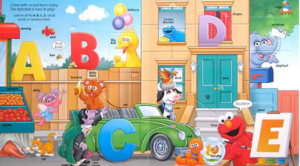
- I love anything with Sesame Street characters for this age as well. I think Sesame Street does a great job with their books (Figure 7.8).
Young Children
Young children can exhibit many of the same preferences and behaviors as toddlers (Video 7.4). They may wiggle away and prefer to play rather than read. They may enjoy reading books over and over again or they may like reading a different book each day.
The best thing to do for young children is to vary the selection of books to get their attention. Alternatively, you may have to read the same book over and over to get their attention.
Short List of Recommendations for Young Children:
- Predictable books with a strong picture and text match are ideal for young children.Books from Eric Carle, Donald Crews, Molly Bang, and Lois Ehlert are excellent choices.
- Many Dr. Seuss books are elaborate with detailed stories (e.g., Horton Hears a Who; The Lorax). Toddlers can’t sit still through a long Dr. Seuss book, but young children can. The language is interesting and some of the vocabulary is made up. When you come across funny words, play with the pronunciation and tone.
- I like funny books. So do young children. Check out the books on the Sid Fleishman Humor Award list. http://www.scbwi.org/awards/sid-fleischman-award/
- The Ted Geisel Award is given to books that are perfectly suited for young, emergent readers. http://www.ala.org/alsc/awardsgrants/bookmedia/geiselaward
- Anything by Maurice Sendak. Wild Things. Enough said.
-

Figure 7.9. I loved Richard Scarry as a child. His illustrations were intricate with hidden sub-plots. Excerpts from What Do People Do All Day? by Richard Scarry, 1968, New York, NY: Random House. Copyright 1968 by Richard Scarry. Some classics include:
- Arnold Lobel—Frog and Toad;
- Richard Scarry—Busy books (Figure 7.9);
- Rosemary Wells—Max and Ruby, Sophie, Yoko, Nora.
- I also love anything by Mo Willems for this age group. He is funny for kids and funny for adults. He used to work for Sesame Street and he really knows how to write for young children and their grown-ups.
- Henry Cole and Doreen Cronin are also excellent picture book creators for this age group.
- Picture books come in all shapes and sizes. Check out pop-up books. Young children can visit the library and check out several at a time. It’s great to have variety.