Chapter 8: Wordless Books
Introduction
“Stories without words” is the phrase used to search for wordless picture books in the public library system. While some wordless books contain a limited number of words beyond the title and author, the focus is on the illustrations telling a story. The storylines vary in complexity and invite readers of all ages to use their own words and let the story unfold through the power of illustrations.
Main Content
As indicated by the search phrase “stories without words”, wordless picture books tell a story. They are not, for example, concept books such as an alphabet book or a book whose purpose is to teach shapes. While they are often introduced as part of an early childhood genre, wordless picture books are not limited to an audience of preschool children who are not yet readers. Rather, there are wordless picture books that would delight and intrigue an advanced reader.
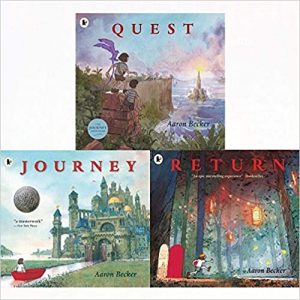
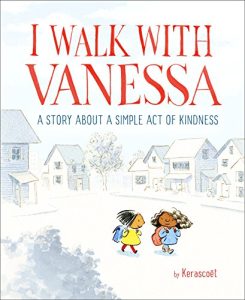
Not only do wordless books appeal to a wide audience in terms of age, they also represent many different genres. For example, I Walk with Vanessa: A story about a simple act of kindness by Kerascoet is a realistic fiction book that tells the powerful story of how one child can stand up for another child who is being bullied. One could also escape to the fantasy world created by Aaron Becker in his wordless book trilogy: Journey, Quest, and Return.
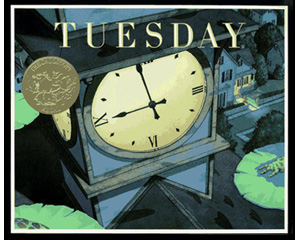
 It is the art in a wordless book that tells the story. David Wiesner (2021), a prolific author of wordless books, describes wordless books on the website Louder than Words: A History of Wordless Storytelling by saying “While similar pictorial choices are made when illustrating books with and without text, in a wordless book the art requires a more intense visual focus on communicating the narrative.” An exploration of the art in Wiesner’s books captivates the reader and has earned him the prestigious Caldecott Medal three times, two of which were for his wordless books: Tuesday (1992), and Flotsam (2006). Those titles are examples of quality wordless books or as Serafini defines as “visually rendered narrative books or as Fras” (Serafini, 2014, p. 24).
The reader interprets the art and imagines the words, whether they are shared orally or stay in the reader’s head. This is a unique aspect of wordless books in that the creation of the story involves collaboration with the reader, and the interpretation of the story may vary by reader. Instead of defining wordless books as being without words as the search term indicates, wordless books are stories with a visual focus and may contain a few words or none beyond the title page at all. So, pick up a wordless book from the list below and imagine the story that could unfold.
Would you like to hear from wordless picture book authors David Wiesner, Molly Bang, Raúl Colón, Marla Frazee, and Eric Rohmann? Listen to these lectures housed on the Eric Carle Museum youtube channel: https://youtu.be/RO48A32wn9o
You can also hear from David Wiesner, Matthew Cordell, Barbara Lehman, and Chris Raschka: https://youtu.be/QjcptJt58-w
Evaluation Questions
- Do the illustrations give readers space to interpret the story in their own way? (Illustrations depict the story when text is not enough for readers to imagine the story, but if the illustrations are too straightforward, the readers can only learn one message from the story, while the story can convey several messages.)
- Is this a book with pictures, or is there a storyline you can follow solely by looking at the pictures? (A book with pictures and no storyline is just that and is typically targeted more toward babies who are learning to identify objects with no need for more detail or explanation. A story without words tells a story by looking at a sequence of pictures in order that follows a storyline without the use of words. )
- Are there quality illustrations? (The pictures in a wordless book need to be captivating and allow the reader to spark imagination.)
- Does the story follow a clear sequence of events? (Since wordless books have no text, in order for children to be able to interpret a wordless book, we must first ensure that the art is clear enough to display its story.)
Benefits
Wordless books appeal to a wide audience. Children who are not yet readers, English learners, and proficient readers alike can immerse themselves in a wordless picture book.
When children “read” a wordless book, they focus on the visual representation of the story. They must pay attention to the art, colors, layout, and nuances such as the expressions on the character’s faces to tell the story. Wordless books spark imagination and build oral language skills as children share their ideas and also listening skills if an adult is interacting with them through the storytelling. Wordless books also build comprehension skills and story structure. They could even serve as a prompt for writing. When children share their stories either orally or through writing, they also learn of varying perspectives.
You may be wondering how to “read” a wordless picture book with a child. First, there is not a right or wrong way to read a wordless book. Just as you might share a picture book that contains words, you can begin with the cover, title, and author. Perhaps even take a picture walk and make initial predictions. Just as repeated readings of books with words are important, taking the time to interact with a wordless book multiple times may benefit the storytelling. In fact, multiple exposures may lead to different storylines being created. No matter the age of the reader, take the time to explore the art and let your imagination wonder.
Books
- Becker, A. (2013). Journey. Candlewick Press.
- Lee, S. (2017). Lines. Chronicle Books.
- Lee, J. (2015). Pool. Chronicle Books.
- Lawson, J. (2015). Sidewalk flowers. Groundwood Books.
- Thomson, B. (2013). Fossil. Two Lions.
- Idle, M. (2013). Flora and the flamingo. Chronicle Books.
- Thomson, B. (2010). Chalk. Marshall Cavendish Children.
- Baker, J. (2010). Mirror. Candlewick Press.
- Cordell, M. (2017). Wolf in the snow. Feiwel & Friends.
- Wiesner, D. (2006). Flotsam. Clarion Books.
- Raschka, C. (2011). A ball for Daisy. Schwartz & Wade Books.
- Boyd, L. (2014). Flashlight. Chronicle Books.
- Anno, M. (1977). Anno’s journey. Fukuinkan Shoten Publishers.
- Allsburg, C. V. (1984). The mysteries of Harris Burdick. Houghton Mifflin Company.
- Pinkney, J. (2009). The lion and the mouse. Little, Brown Books for Young Readers.
Additional Information
Undergraduate students in a Children’s Literature class created their own summaries of recommended wordless books. While you may create a different storyline from your reading, these summaries may help you in selecting wordless books.
Marlin Ageb presents Another by Christian Robinson, 2019
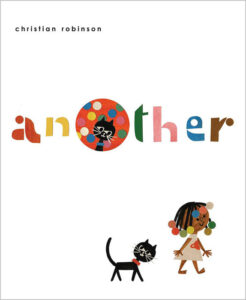 One night, a little girl and her kitten were trying to sleep. As soon as the little girl fell asleep, a portal opened. The kitten looked on with shock as another kitten that looked exactly like her came into the room, and took her favorite toy mouse. The little girl is awoken by her kitten as he jumps off the bed, following the copy cat’s lead. She is intrigued by the huge hole that has magically appeared in her room. She follows her kitten into a wild new world, as the kitten follows her favorite toy, where everything is better and more fun. They climb stairs, play in a ball pit, run on a treadmill, and then they find other friends. They watched as the friends played on the seesaw, played with a hoolahoop, drew, and had a picnic. Along with her new friends, the little girl met so many more new, cool friends of all different ethnicities and backgrounds. Eventually, the copycat led them to their owner and the little girl saw herself in a different light. They got the cat’s favorite toy mouse back, went home, then fell back asleep. Little did they know, the copy cat’s favorite toy mouse was on their bed this whole time.
Annie Hall presents Flora and the Flamingo by Molly Idle, 2013
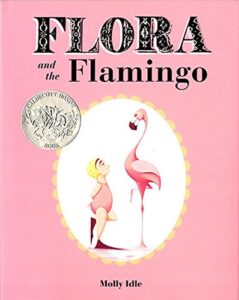 In this story, two unlikely friends, Flora and Flamingo, learn how to approach the trials and tribulations of friendship through dance. They begin their friendship trying to move through the steps of friendship as individuals. They do twists and turns, and poses all in sync. But, flamingo is different in ways that Flora can not do all of the same things that the flamingo can. So when she tries, she falls down and gets upset. This is when the careful and caring dance of friendship is tested and the flamingo is there to answer the call. The flamingo goes over to Flora, who is upset and sitting turned away from flamingo, and flamingo offers Flora a hand. Then, they move through the difficulty and learn to dance through friendship, working together with grace and joy.
Jessica Jekanowski presents Wolf in the Snow by Matthew Cordell, 2017
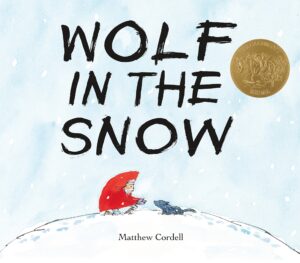
Wolf in the Snow by Matthew Cordell tells the story of a girl who went to school and ended up getting caught and lost in a snowstorm on her way back home. As she is lost, trying to find her way back, she runs into a wolf pup who got separated from their pack and is also lost. The girl takes the pup with her as she continues to walk likely because the pup reminds her of her pet dog. She searches for the pup’s pack in order to reunite them and eventually encounters the pup’s mom. Luckily she is able to return the pup safely without being hurt. Afterwards, she has to continue walking through the storm to try and get home, however, she runs out of energy and collapses in the snow. There the wolf pack finds her and howls in order to communicate with the girl’s dog who is barking in the distance. The wolves efforts are successful and the girl’s father along with the dog, find her and take her back home.